Google AI Overviews now answer before users even scroll. If your entire SEO strategy is built around clicks and rankings, you're optimizing for a game that's already changed. Here's what to do instead.
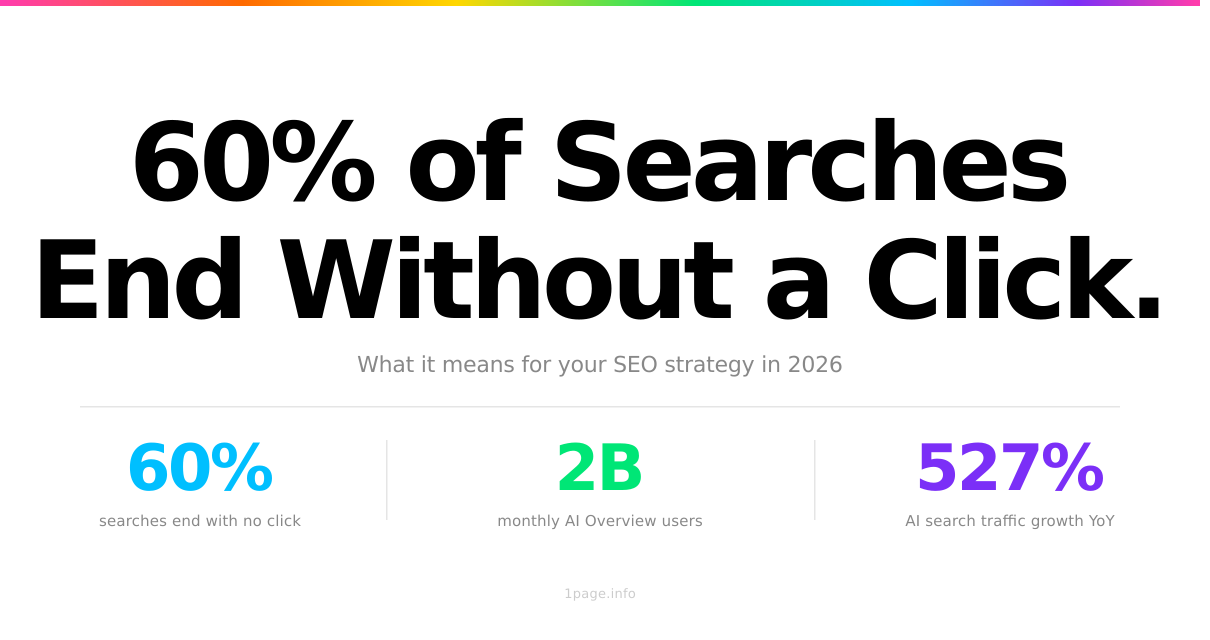
Something quietly alarming happened to SEO in 2026 — and most businesses haven't noticed yet.Roughly 60% of all Google searches now end without a single click. No website visit. No landing page. No conversion opportunity. The user asked a question, Google's AI answered it right there on the search results page, and they moved on.That's not a bug. That's the new normal.Google AI Overviews now reach over 2 billion monthly users. AI search traffic has grown 527% year over year. ChatGPT alone has 700 million weekly active users who are bypassing Google entirely for exploratory queries. The way people find information online has fundamentally changed — and if your SEO strategy still lives and dies by keyword rankings and organic click-through rates, you're already behind.
The Zero-Click Search Problem:
Zero-click searches aren't new, but AI Overviews have supercharged them. When someone searches "best CRM for small business" or "how to improve website conversion rate," Google's AI now generates a complete summary answer at the top of the page — pulling from multiple sources, synthesizing them, and presenting a final answer without the user needing to visit any website.This means your page can rank #1 on Google and still get no traffic.Traditional SEO metrics like rankings, impressions, and organic clicks are becoming incomplete signals. Brands that only track these are flying blind.
So What Do You Optimize For?
This is where a new discipline comes in: Generative Engine Optimization, or GEO.GEO is the practice of optimizing your content so that AI-powered search platforms — Google AI Overviews, ChatGPT, Perplexity, Gemini, Claude — retrieve, cite, and recommend your brand when generating answers. If traditional SEO was about ranking in 10 blue links, GEO is about earning a spot in the 2–7 sources an AI engine cites in a single response.The simplest way to think about it: SEO gets you ranked. GEO gets you cited.
How to Start Optimizing for GEO Right NowThe good news —
GEO doesn't replace SEO. It builds on it. High-ranking content is still the foundation AI engines pull from. But there are specific things you need to add:Write to answer questions directly. AI engines love content that leads with a clear, direct answer before adding context. Structure every article, landing page, and blog post around real questions your audience types into search.Add original data, statistics, and expert quotes. Research from Princeton University shows that citing sources, including statistics, and adding expert quotes can improve AI citation rates by 30–40%. Generic content gets skipped. Specific, credible content gets cited.Build author authority. AI search has a strong trust bias toward content tied to real, credible people. Add author bios with credentials to every piece of content. Create a detailed author page. Google's E-E-A-T signals (Experience, Expertise, Authoritativeness, Trustworthiness) now directly influence GEO performance.Earn third-party brand mentions. Digital PR, podcast appearances, industry directory listings, and community mentions are no longer just brand-building activities. They directly influence whether your brand appears in AI-generated search results.Use structured formatting. Clear heading hierarchies (H1, H2, H3), bullet points, numbered lists, and FAQ schema markup make your content easier for AI systems to parse and synthesize.
The Opportunity Window Is Open
Here's the part most brands are missing: 47% of businesses still have no GEO strategy at all. The competitive window is wide open right now. Citation authority, like domain authority before it, compounds over time. The brands that start building it in 2026 are the ones AI engines will default to in 2027 and beyond.Zero-click doesn't mean zero opportunity. It means the opportunity has moved — from the click to the citation.If your brand isn't being mentioned in AI-generated answers, you're invisible to a growing segment of your highest-value audience. AI search visitors convert at 4.4x the rate of traditional organic visitors. Lower volume, dramatically higher value.Stop optimizing only for rankings. Start optimizing to be cited, referenced, and recommended by the AI engines your customers are already using every day.
That's the SEO strategy for 2026.
The Zero-Click Search Problem:
Zero-click searches aren't new, but AI Overviews have supercharged them. When someone searches "best CRM for small business" or "how to improve website conversion rate," Google's AI now generates a complete summary answer at the top of the page — pulling from multiple sources, synthesizing them, and presenting a final answer without the user needing to visit any website.This means your page can rank #1 on Google and still get no traffic.Traditional SEO metrics like rankings, impressions, and organic clicks are becoming incomplete signals. Brands that only track these are flying blind.
So What Do You Optimize For?
This is where a new discipline comes in: Generative Engine Optimization, or GEO.GEO is the practice of optimizing your content so that AI-powered search platforms — Google AI Overviews, ChatGPT, Perplexity, Gemini, Claude — retrieve, cite, and recommend your brand when generating answers. If traditional SEO was about ranking in 10 blue links, GEO is about earning a spot in the 2–7 sources an AI engine cites in a single response.The simplest way to think about it: SEO gets you ranked. GEO gets you cited.
How to Start Optimizing for GEO Right NowThe good news —
GEO doesn't replace SEO. It builds on it. High-ranking content is still the foundation AI engines pull from. But there are specific things you need to add:Write to answer questions directly. AI engines love content that leads with a clear, direct answer before adding context. Structure every article, landing page, and blog post around real questions your audience types into search.Add original data, statistics, and expert quotes. Research from Princeton University shows that citing sources, including statistics, and adding expert quotes can improve AI citation rates by 30–40%. Generic content gets skipped. Specific, credible content gets cited.Build author authority. AI search has a strong trust bias toward content tied to real, credible people. Add author bios with credentials to every piece of content. Create a detailed author page. Google's E-E-A-T signals (Experience, Expertise, Authoritativeness, Trustworthiness) now directly influence GEO performance.Earn third-party brand mentions. Digital PR, podcast appearances, industry directory listings, and community mentions are no longer just brand-building activities. They directly influence whether your brand appears in AI-generated search results.Use structured formatting. Clear heading hierarchies (H1, H2, H3), bullet points, numbered lists, and FAQ schema markup make your content easier for AI systems to parse and synthesize.
The Opportunity Window Is Open
Here's the part most brands are missing: 47% of businesses still have no GEO strategy at all. The competitive window is wide open right now. Citation authority, like domain authority before it, compounds over time. The brands that start building it in 2026 are the ones AI engines will default to in 2027 and beyond.Zero-click doesn't mean zero opportunity. It means the opportunity has moved — from the click to the citation.If your brand isn't being mentioned in AI-generated answers, you're invisible to a growing segment of your highest-value audience. AI search visitors convert at 4.4x the rate of traditional organic visitors. Lower volume, dramatically higher value.Stop optimizing only for rankings. Start optimizing to be cited, referenced, and recommended by the AI engines your customers are already using every day.
That's the SEO strategy for 2026.
Written by
Alice SEO
Content contributor at 1page.info. Sharing knowledge and insights about industries, digital trends, and business strategies.