
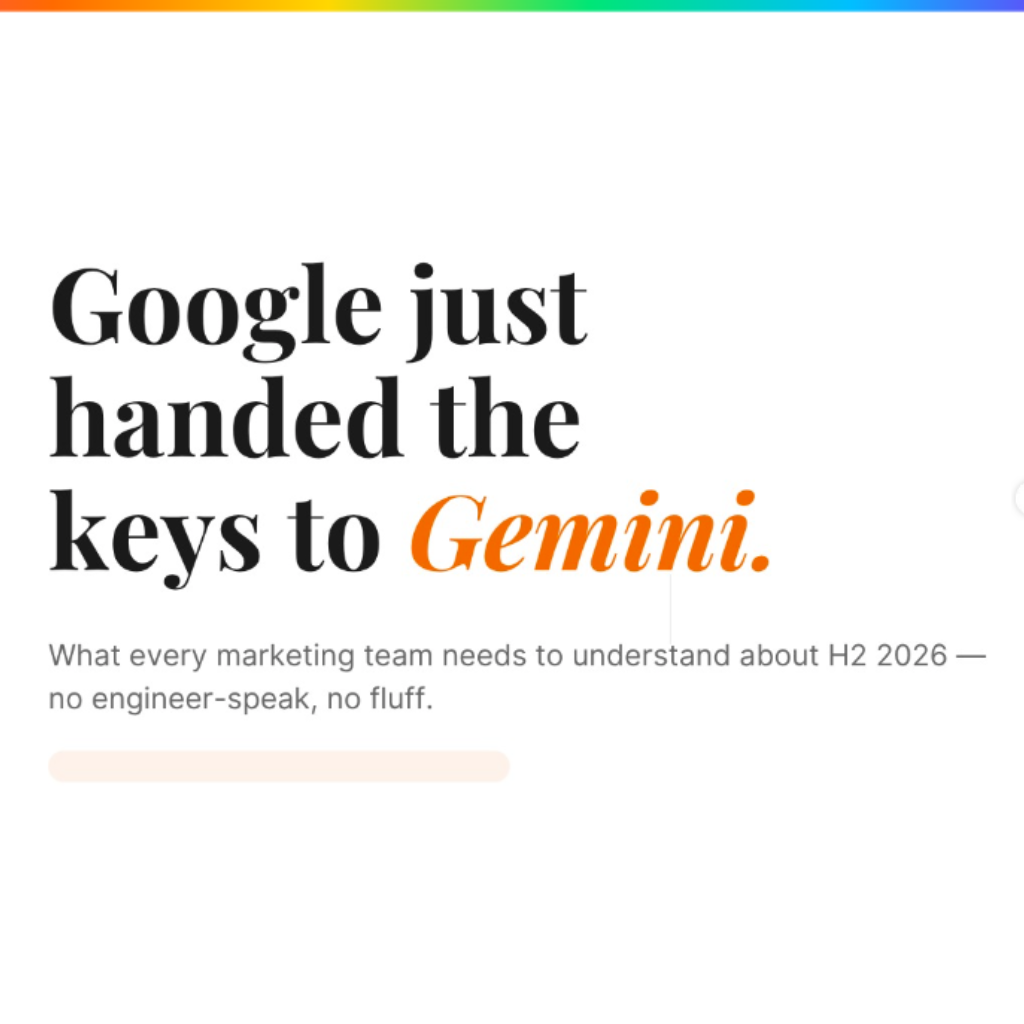
GML 2026 wasn't just another product announcement. Google confirmed that Gemini AI is now the operating system underneath every Google Ads campaign — Search, PMax, Demand Gen, Display. Here's what changed, what it means for your team, and exactly what to do this week.
At Google Marketing Live 2026, Google made one thing crystal clear: Gemini AI is no longer an optional feature inside Google Ads. It is now the operating system underneath every campaign type you run — Search, Performance Max, Demand Gen, and Display.
Bidding logic, audience modeling, creative generation, and budget allocation all flow through a single Gemini-powered backbone. This isn't a minor update. It's a fundamental shift in how Google Ads works — and most marketing teams aren't ready for it.
The era of manual optimization is over.
For years, competitive advantage in Google Ads came from who could configure campaigns better. Tighter bidding rules. Smarter audience layers. More granular ad group structure. Gemini now handles all of that. Your value as a marketer has moved upstream — to the quality of the inputs you feed the machine.
Better creative assets. Cleaner first-party data. Sharper conversion signals. That's where the game is won now.
5 GML 2026 announcements that change how you work:
Gemini Creative Studio brings AI-generated video, image, and copy assets directly into your campaign workflow — no external tools needed. Unified Bidding Intelligence runs one bidding brain across Search, PMax, and Demand Gen simultaneously, making channel-level budget silos increasingly irrelevant. First-Party Data Mesh lets you connect your CRM, CDP, and offline data into a single privacy-safe layer for Gemini to optimize against — making first-party data your biggest competitive advantage. Predictive Audience Composer automatically builds and refreshes audience segments based on your conversion patterns, reducing the need for manual audience management. Brand Safety Guardrails 2.0 gives you new controls to set tone, placement rules, and creative boundaries that Gemini must respect.
The risk nobody is talking about.
If your measurement stack is messy, Gemini will optimize toward the wrong things — and it will do it at scale. Duplicate conversions, vanity signals, low-quality micro-conversions — Gemini doesn't know the difference unless you clean it up first. Measurement quality is no longer a back-office concern. It is now central to campaign performance.
What your team should do this week:
Audit your conversion actions and remove anything low-quality or redundant. Rebuild your creative as modular components — individual headlines, images, and CTAs that Gemini can recombine freely. Set up incrementality testing before you let Gemini scale your spend. Reframe ad copy as raw input for Gemini rather than finished creative output. And define your brand guardrails inside the platform now, using Brand Safety Guardrails 2.0, before Gemini makes those decisions for you.
The bottom line: The tools are democratized. Every competitor gets the same Gemini AI. The difference between teams that grow and teams that waste budget in H2 2026 comes down entirely to strategic inputs — better data, sharper briefs, and cleaner measurement. Strategy is the only moat left. The window to adapt is now, not next quarter.