
The Dawn of AI-Native Product Creation
As we navigate through 2026, artificial intelligence (AI) is not simply supplementing product development—it’s fundamentally rewriting the rules. From ideation to launch, AI-driven tools and methodologies are accelerating innovation, reducing costs, and ushering in a new era of empowered product builders. In today's fast-paced digital landscape, those who embrace AI are outpacing competitors and redefining what’s possible in the world of product design and delivery.
From Product Managers to Product Builders
Traditionally, product managers have acted as the linchpin between engineering, design, and business teams. However, the landscape is rapidly evolving. According to the 2026 CPO Impact Report, the number of conventional product manager roles has dropped by 30% overall—and a staggering 70% in SaaS companies. But this isn’t a story of loss; it’s one of transformation. AI is fostering the rise of the "product builder": versatile professionals who blend product thinking, technical fluency, design sensibility, and business acumen. Their ability to move rapidly from concept to execution is amplified by AI-driven platforms, and their ranks have nearly tripled in recent years.
AI’s Impact at Every Stage of Product Development
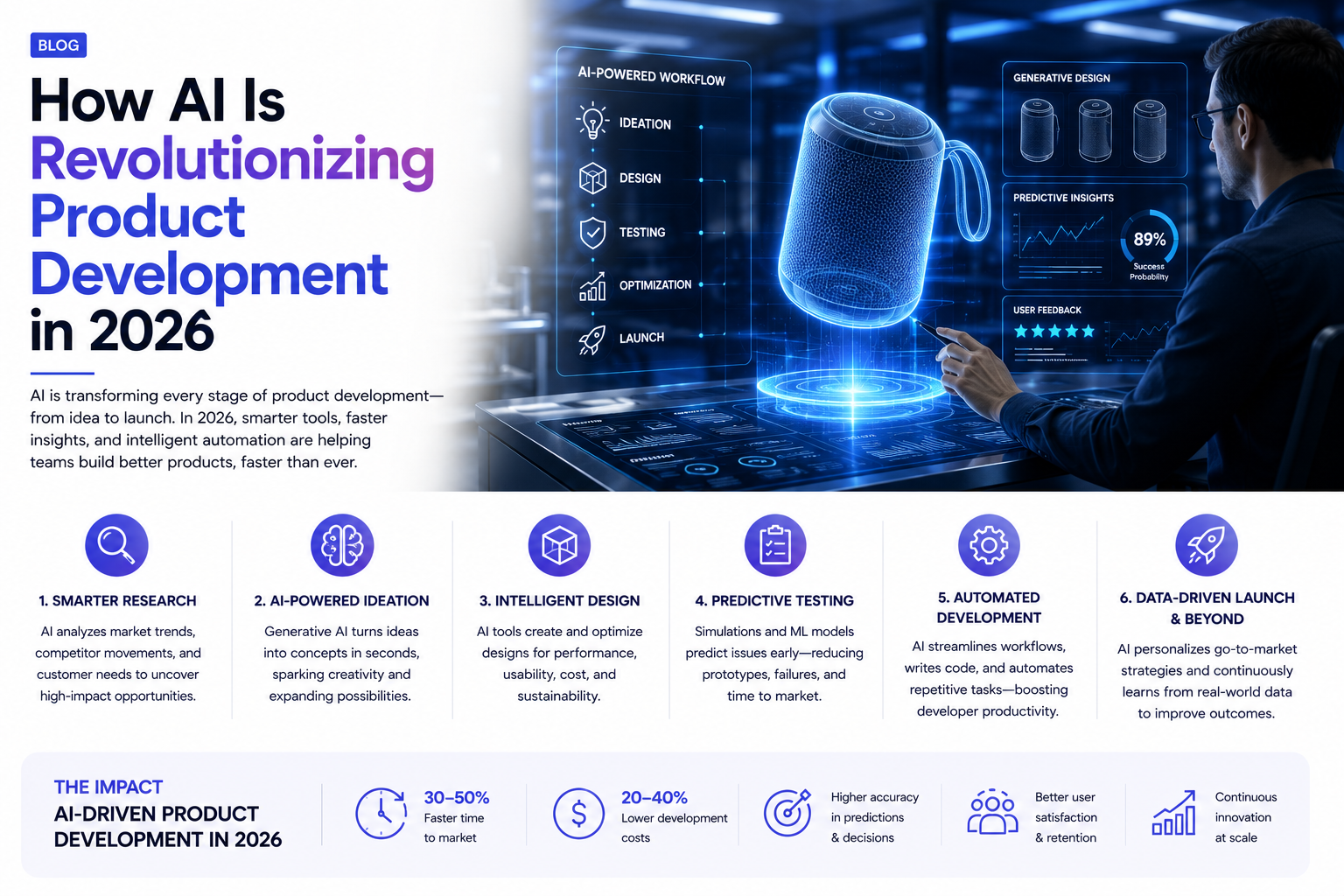
- Ideation & Market Research: AI engines can process and analyze vast quantities of market data, customer feedback, and emerging trends. This enables teams to identify promising opportunities and validate ideas with unprecedented speed and accuracy.
- Design & Prototyping: Generative AI tools now create design prototypes, user flows, and wireframes in minutes, not weeks. These tools learn from past projects and industry data, ensuring that designs are both innovative and user-friendly.
- Development: AI-powered code generators, test automation, and low-code/no-code platforms mean that building complex products is faster and more cost-effective. Execution bottlenecks are shifting from engineering limitations to strategic decision-making.
- Testing & QA: Machine learning models automatically detect bugs, optimize user experiences, and predict potential product failures, drastically reducing the time to market and improving reliability.
- Launch & Growth: AI-driven analytics track customer behavior, suggest product improvements, and personalize user experiences on the fly, ensuring continuous iteration and growth.
The New Bottleneck: Human Judgment
While AI handles much of the execution, the critical challenge for organizations in 2026 is determining what to build and why. With execution nearly automated, strategic clarity and human creativity have become the real differentiators. Successful teams are those that excel at asking the right questions, setting clear priorities, and leveraging AI insights for bold decision-making.
Collaboration and the Rise of Cross-Functional Teams
AI’s pervasive role is dissolving traditional silos. Product development now demands cross-functional teams where designers, engineers, marketers, and data scientists collaborate in real time. AI acts as both a facilitator and an equalizer, surfacing insights and automating routine tasks so humans can focus on higher-order thinking and creative problem solving.
- Real-Time Insights: AI tools provide instant feedback on prototypes and user flows, allowing for rapid iteration across disciplines.
- Integrated Workflows: Cloud-based AI platforms enable seamless handoffs between design, engineering, and business teams, keeping everyone aligned on goals and progress.
- Enhanced Creativity: With AI handling repetitive work, teams have more time and mental bandwidth to experiment, innovate, and refine their visions.
AI-Driven Personalization and Customer Engagement
One of the most exciting trends in 2026 is the rise of hyper-personalized products. AI algorithms analyze user behavior in real time, enabling companies to tailor features, content, and interfaces to individual preferences. This not only drives engagement and loyalty but also sparks new revenue streams through premium, customized experiences.
Challenges and Ethical Considerations
Despite these advancements, the AI-driven product development landscape is not without challenges. Teams must navigate concerns around data privacy, algorithmic bias, and the risk of over-automation. Moreover, as AI reshapes roles and responsibilities, organizations must invest in upskilling and reskilling their workforce to maintain a competitive edge.
- Data Ethics: Ensuring responsible data use and transparency in AI decision-making is essential for building trust with users.
- Human Oversight: While automation is powerful, human judgment is crucial for ethical and strategic decisions.
- Continuous Learning: Companies must foster cultures of lifelong learning, encouraging employees to adapt and grow alongside technology.
Looking Ahead: The Future of Product Development
The rise of AI-native product builders is just the beginning. As AI capabilities continue to advance, we can expect even more radical changes in how products are conceived, built, and scaled. Organizations that prioritize agility, strategic clarity, and ethical responsibility will be best positioned to thrive in this new era.
In summary, AI is not replacing humans in product development—it’s empowering them to achieve more than ever before. Those who harness the synergy between human creativity and machine intelligence will lead the next wave of innovation.
References
- Products That Count CPO Impact Report 2026
- Forbes, "AI Is Rewriting The Rules Of Product Development," 2026
Subscribe for more insights—less than $2 per week!