
Student panic is a moment where coaching centers can either exploit or empower. The difference determines whether you build a business or build a movement.
The Crisis Moments in Education
They happen regularly:
- Papers leak (NEET, JEE, board exams)
- Exam dates change unexpectedly
- Results get delayed
- Curriculum gets revised mid-year
- Cut-offs spike unpredictably
- Admit cards don't arrive on time
Each crisis creates a 2-4 hour window where students are frantically searching for answers. Parents are stressed. Social media explodes with panic posts and misinformation.
This is where most coaching centers go silent or post generic motivational content. Smart centers go live and solve the actual problem.
The Real-Time Response Strategy
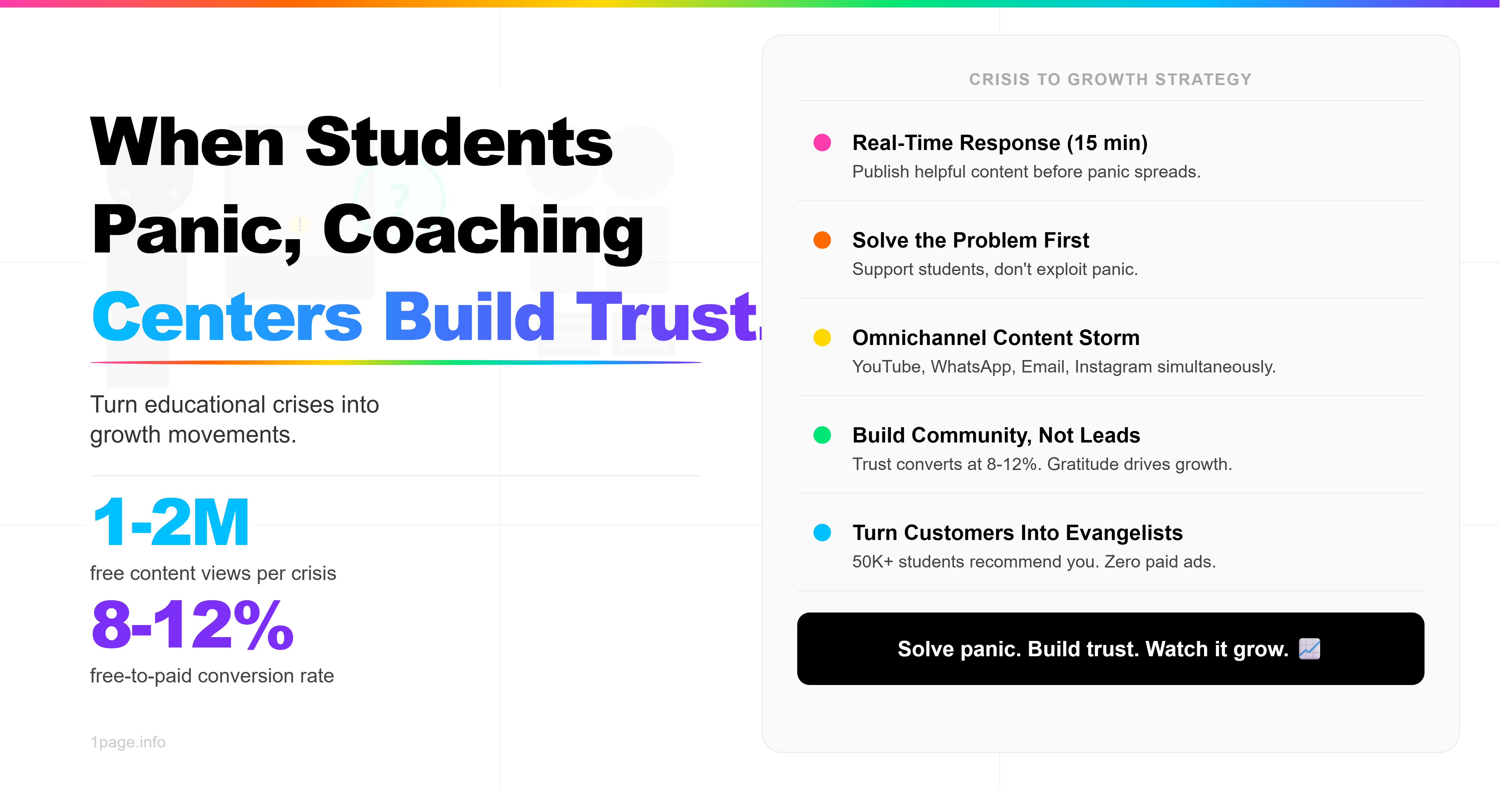
When a crisis hits, smart coaching centers publish within 15-30 minutes.
Not a sales pitch. A solution.
A video: "Paper leaked? Here's what to do in the next 2 hours."
A WhatsApp message: "Exam dates changed. Here's your new study plan."
A live session: "Curriculum shifted. Here's what to focus on."
An email: "Cut-offs spiked. Here's what this means for your strategy."
The content covers:
- What just happened (honest, factual explanation)
- What students should do now (actionable steps)
- What this means long-term (realistic perspective)
- Free resources to help (real value, no gatekeeping)
By the time the crisis goes viral, the coaching center has already provided the answer. Students don't see a business trying to capitalize on panic. They see a trusted authority solving chaos.
The Content-SEO Genius
Here's where digital marketing strategy kicks in. Every crisis creates high-intent keywords.
"Paper leaked what to do" — 1M+ searches in 2 hours
"Exam dates changed how to prepare" — 500K+ searches
"Board exam curriculum changes" — 300K+ searches
"JEE cut-offs increased what now" — 200K+ searches
A coaching center that publishes helpful content in the first 60 minutes captures all of this organic search traffic. They rank on Google. They go viral on YouTube. They dominate Twitter/X.
And the content genuinely helps students, not exploits them.
The Community Activation Play
Smart coaching centers have built WhatsApp communities of 10,000-50,000 students. When a crisis hits, they don't send a sales message.
They send real-time support.
"Paper leaked. Don't panic. Here's your game plan:
Hour 1: Review the paper. Mark weak topics. Stop.
Hour 2: Solve 5 questions from each weak area using our free resources.
Before exam: Sleep. Your preparation until today matters, not cramming tonight.
Join our 6 PM live session for exam strategy."
This message does three things:
- Solves immediate panic
- Provides actual value (free resources, strategy)
- Builds trust (students see the center genuinely cares)
Conversion happens not because of selling. It happens because of genuine help. By evening, 40-50% of those students join the live session. By next week, 8-12% have become paying customers.
The Omnichannel Content Storm
When a crisis hits, smart coaching centers post simultaneously across all platforms.
YouTube: 15-minute detailed analysis videos
Instagram Reels: 60-second panic-solving tips
TikTok: Raw, authentic reaction content
Twitter/X: Real-time updates and expert opinions
Email: Structured support sequences
WhatsApp: Immediate action steps
LinkedIn: Thought leadership angle
Each piece of content is tailored to the platform but carries the same message: "We're here to help you through this."
A single crisis can generate:
- 1-2M content views
- 200K-400K email subscribers
- 50K-100K new social followers
- 8,000-12,000 paid conversions
The Email Funnel Strategy
Every student who engages with free content gives their email in exchange for study materials, schedules, or tips.
Smart coaching centers build a 7-email sequence:
Email 1 (During crisis): "Here's your game plan"
Email 2 (Next day): "How to recover from panic"
Email 3 (A few days later): "What to focus on now"
Email 4 (Before exam): "Managing exam anxiety"
Email 5 (Day before): "Final checklist"
This isn't aggressive selling. It's treating students like human beings going through an emotional journey. By email 7, 25-30% have converted to paid customers — not because they were sold to, but because they experienced genuine value.
The Influencer & Authority Strategy
Smart coaching centers don't just broadcast. They amplify through trusted voices.
They partner with:
- Students who scored 650+ (NEET toppers)
- Biology/Chemistry/Physics content creators (100K+ followers)
- Educational YouTubers
- Reddit moderators in exam communities
When a crisis hits, these influencers post authentic recommendations:
"Paper leaked. Here's my analysis. I used [coaching center] to prepare, and here's why I recommend them."
This isn't paid promotion. It's authentic trust transfer from people students already follow.
The Media & PR Angle
News outlets want stories during educational crises. Smart coaching centers provide them.
"How to support students during exam panic: Coaching center launches free crisis support"
"Educational experts react to curriculum changes: Here's what students need to know"
"Paper leak: Coaching center releases emergency study resources"
Media picks up the story because there's genuine news value. The coaching center gets credibility and reach without buying ads.
Why This Builds Unstoppable Growth
Most education businesses chase transactions. Smart coaching centers chase trust.
When a crisis hits:
- Anxious students get free help → they feel supported
- Supportive content goes viral → brand awareness explodes
- Free content converts at 8-12% → revenue scales organically
- Email sequences nurture relationships → lifetime value builds
- Media coverage → credibility compounds
- Alumni recommend → word-of-mouth amplifies
A single crisis can generate ₹5-10 crore in revenue for a coaching center.
The Long-Term Play
The real genius is this: when a coaching center consistently shows up during crisis moments, they stop being a business. They become a movement.
Students don't just enroll. They recruit. They defend the center online. They become evangelists.
A parent whose child was panicked during a paper leak, saw free help from a coaching center, and scored well doesn't just become a customer. They become an advocate.
By the time results are out, the coaching center doesn't need paid ads. 50,000 students are telling their friends: "That center actually cared about my preparation, not just my money."
The Digital Marketing Principle
This is the future of education marketing:
- Don't capitalize on crisis. Solve crisis.
- Don't sell during panic. Support during panic.
- Don't chase transactions. Chase trust.
- Don't build customers. Build communities.
- Don't make money from fear. Make money from gratitude.
A coaching center that masters this grows 10X faster than competitors selling hard during panic. Because they're not competing on price or promises. They're competing on genuine care — the one thing that can't be replicated.
And in education, where parents are investing their child's future, genuine care is the most profitable strategy there is.