
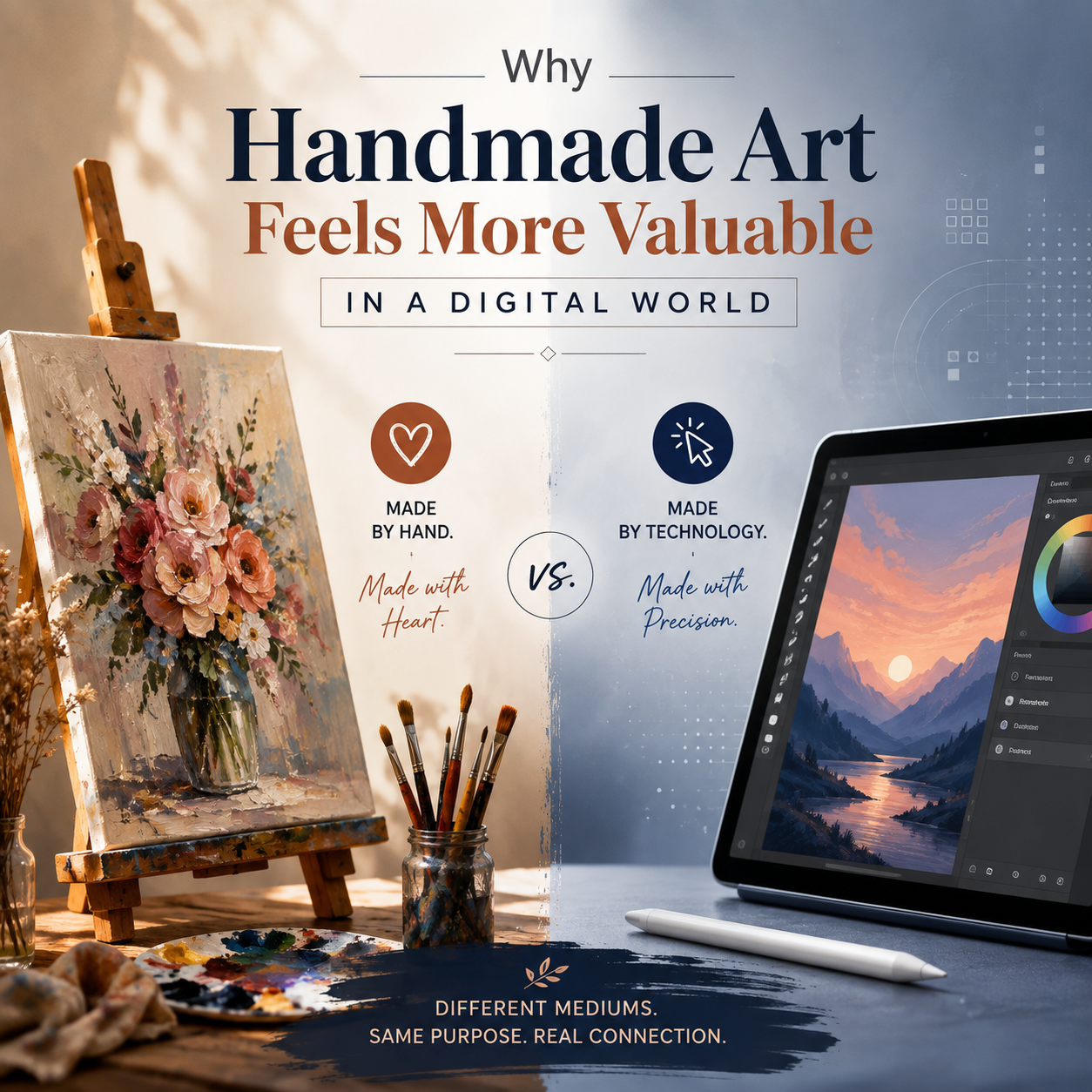
When almost anything can be created with a click, why does something made by hand feel different?
The Rise of Digital Art—and the Enduring Appeal of Handmade Creations
We live in a time when technology enables anyone to create beautiful images with just a few keystrokes. Artificial intelligence can generate stunning visuals, and digital prints can be mass-produced in seconds. Despite this, people continue to seek out and cherish handmade artwork. Why is that? What makes a painting, sculpture, or craft created by human hands feel so much more valuable in our increasingly digital world?
The Emotional Resonance of Handmade Art
There’s something deeply personal about handmade art. Each brushstroke, carved line, or stitched thread carries the imprint of its creator. Unlike digital art, which can be endlessly replicated, a handmade piece is inherently unique. It tells a story—not just through its subject, but through the process of its creation. This emotional resonance is a big part of why people are drawn to handmade work, even as digital art becomes more prevalent.
The Human Touch: Imperfections and Authenticity
One of the most celebrated aspects of handmade art is its imperfections. Slight variations in color, texture, or form are not flaws—they are signatures of authenticity. These quirks remind us that a real person, with real emotions and intentions, crafted the piece. In contrast, mass-produced décor or AI-generated images often feel sterile and detached. Their perfection can actually make them less relatable, less alive.
- Fingerprints in clay: A potter’s fingerprints on a vase offer a direct connection to the maker.
- Uneven brushstrokes: A painter’s visible brushwork adds depth and character to a canvas.
- Hand-stitched threads: A textile artist’s irregular stitches create texture and charm.
These imperfections become part of the story—proof that the object was lovingly made, not simply produced.
Handmade vs. Mass-Produced: What’s the Difference?
Mass-produced art is designed for efficiency and uniformity. It can be found everywhere, from big-box stores to online marketplaces. While these pieces may be attractive, they often lack the soul of something handmade. The difference is palpable:
- Uniqueness: Every handmade piece is one-of-a-kind. Mass-produced items are identical, making them less special.
- Connection: Handmade art often comes with a backstory. You might know the artist’s name, see their photo, or read about their inspiration. Mass-produced art is anonymous and impersonal.
- Value: Original, handmade works can become cherished heirlooms, increasing in sentimental (and sometimes financial) value over time.
Connecting with the Artist’s Story
When you buy or receive a handmade piece, you’re not just acquiring an object—you’re forging a connection with the person who created it. Many artists share their process, their challenges, and their motivations. This narrative becomes part of the artwork itself. You might display a ceramic bowl in your kitchen, remembering the potter’s story every time you use it. Or you may hang a painting in your living room, knowing it was inspired by a sunset the artist witnessed in their hometown.
This sense of connection is hard to replicate with digital or mass-produced art. Without a human story, the piece can feel empty—a decoration, not a treasure. In a world where much of what we consume is anonymous, handmade art offers a personal link to creativity and tradition.
Personalization: Why Original Art Feels More Intimate
Handmade art is often tailored to its owner. Commissions, custom color palettes, or even collaborative designs allow buyers to become part of the creative process. This personalization makes the finished piece feel uniquely theirs. Digital art can sometimes offer customization, but the experience of working with a living artist—sharing ideas, exchanging feedback, and witnessing the evolution of a piece—adds a layer of intimacy that technology can’t easily replicate.
Examples of Personal Connection
- A hand-painted portrait that captures a loved one’s personality
- A custom piece of jewelry designed for a special occasion
- A woven wall hanging made with colors chosen by the recipient
These experiences turn art into more than just décor—they become cherished memories, mementos of collaboration and connection.
AI, Digital Art, and the Future: Replacement or Complement?
The rise of AI-generated images and digital prints has sparked debate: Are these technologies replacing traditional art forms, or simply offering new tools for expression? In reality, digital and handmade art can coexist—and even enrich each other. Many artists blend digital and traditional techniques, using technology to sketch ideas or enhance their work before finishing pieces by hand.
Digital art offers accessibility and innovation. It allows more people to experiment with creativity, to share their visions instantly with a global audience. But as digital art becomes ubiquitous, the scarcity and tangibility of handmade work become even more appealing. The value of handmade art is not diminished by technology—instead, it’s amplified by contrast.
The Lasting Value of Human Creativity
Ultimately, handmade art stands as a testament to human creativity and resilience. In a world where so much is virtual, physical creations remind us of our roots, our traditions, and our shared humanity. They invite us to slow down, to appreciate the process as much as the product, and to celebrate the imperfections that make us unique.
Conclusion: Why Handmade Art Still Matters
As technology continues to evolve, our appreciation for handmade art only grows stronger. The emotional value, authenticity, and personal connection it offers can’t be replicated by algorithms or machines. Whether displayed in our homes or given as gifts, handmade pieces remind us of the enduring power of human touch in a digital world. And that’s something truly valuable.