
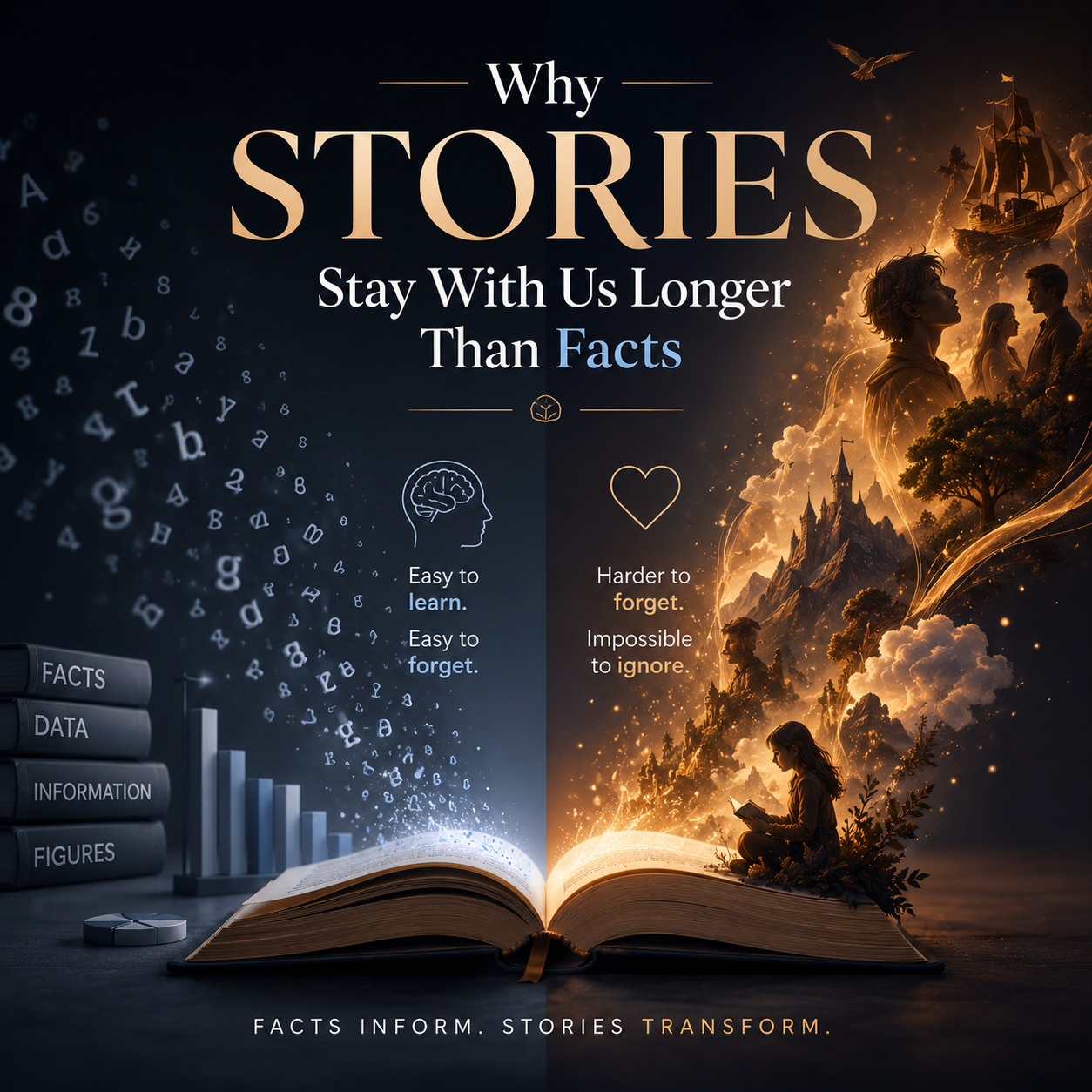
“You might forget what a book taught you. But you probably won't forget how it made you feel.”
Stories vs. Facts: Why Our Brains Naturally Connect with Narratives
Have you ever noticed how the plot of a novel lingers in your mind for years, while the details from a textbook fade almost instantly? There’s a reason for that. Our brains are wired to connect with stories in a way that facts and figures simply can't match. Narratives captivate us, ignite our imagination, and embed themselves into our memories. But why?
When we read or listen to a story, our brains don’t just process words—they simulate experiences. Neuroscientists have found that stories activate multiple parts of the brain, including those responsible for emotions, sensory processing, and even movement. This multisensory engagement turns passive information into an active, memorable experience.
In contrast, isolated facts often lack context and emotional resonance. Without a narrative structure, our brains treat them as fleeting details—harder to recall and easy to disregard.
Characters Create Emotional Memory
Think back to your favorite book or movie. Chances are, the characters left a lasting impression. That’s because we remember people and experiences far better than abstract data. When we follow a character’s journey, their struggles and triumphs become personal to us. We empathize with their motivations, feel their joys and sorrows, and, as a result, remember them long after the story ends.
Psychologists call this phenomenon emotional memory. Emotional experiences trigger the amygdala, the part of the brain involved in processing emotions, which in turn strengthens the encoding and recall of those memories. Characters serve as anchors, transforming theoretical concepts into lived experiences. For example, you might forget the historical dates of World War II, but the story of Anne Frank or Atticus Finch’s moral courage can stay with you for a lifetime.
How Characters Make Facts Sticky
- Relatability: We see parts of ourselves in well-crafted characters.
- Empathy: Emotional investment makes information harder to forget.
- Context: Characters provide a backdrop that gives facts meaning and relevance.
The Power of a Personal Connection
Stories have the unique ability to make abstract ideas feel real and tangible. When a book weaves complex themes—like justice, love, or sacrifice—into the lives of its characters, those themes become more than just words; they become experiences we can relate to.
Consider the difference between reading about the theory of resilience and reading a memoir of someone who overcame adversity. The latter doesn’t just explain resilience—it shows it in action, making the concept vivid and memorable. This personal connection turns learning into something that resonates, rather than just something to be memorized.
Personal narratives also provide us with mental models for understanding the world. When we encounter similar situations in our own lives, we can draw upon the stories we've read as guides for our own behavior and decision-making.
Why Storytelling Works in Education and Business Too
The power of storytelling isn’t limited to novels. Educators and business leaders have long recognized that stories make information stick—whether it’s a history lesson, a science concept, or a brand message.
Education: From Dates to Dramas
- Engagement: Stories capture students’ attention, making learning an active process.
- Retention: Lessons embedded in narratives are easier to recall during exams and in real life.
- Understanding: Complex concepts become accessible when seen through the lens of a story.
For example, teaching the scientific method through the story of a real-life discovery (like Alexander Fleming and penicillin) brings the process to life. Students remember the challenges, the “aha!” moments, and the human element behind the facts.
Business: Stories That Sell
- Brand Loyalty: Companies that share authentic stories foster deeper connections with customers.
- Persuasion: Narratives can simplify complex products or services, making them relatable.
- Motivation: Leaders use stories to inspire teams, communicate vision, and drive change.
Think about the most memorable advertisements or brand campaigns. They rarely focus on technical details; instead, they tell a story that evokes emotion and builds trust.
Can a Good Story Change How We Think?
Stories do more than just help us remember—they have the power to shape our beliefs, attitudes, and decisions. Through narrative, we can see the world from another person’s perspective, which fosters empathy and understanding.
Research shows that when we become immersed in a story, our brains experience what psychologists call narrative transportation. This state makes us more open to new ideas and more likely to change our attitudes in response to compelling narratives. For instance, reading a novel about a culture different from our own can break down stereotypes and broaden our worldview.
- Perspective Shift: Stories let us “walk in someone else’s shoes,” challenging our assumptions.
- Influence: Well-told stories can inspire action, from charitable giving to social change.
- Decision-Making: We often base choices on stories we've heard, rather than pure data.
This influence is why storytelling is such a powerful tool in everything from politics to public health campaigns. A well-crafted narrative can do what facts alone cannot: motivate, persuade, and inspire.
The Takeaway: Facts Inform Us, But Stories Can Make Us Care
In a world overflowing with information, it’s easy to get lost in a sea of facts. But stories cut through the noise. They transform knowledge into something meaningful, memorable, and actionable. While facts are essential—they give us the foundation for understanding—the stories built around those facts are what truly stick with us.
So, the next time you want to remember something—or help someone else remember—wrap it in a narrative. Whether in education, business, or everyday conversation, harness the power of storytelling. After all, it’s not just what we know that matters, but how we connect with it—and with each other—through the stories we share.