The internet was infrastructure. The cloud was infrastructure. AI is next — and the businesses that treat it like an optional tool in 2026 will be structurally behind by 2027. Here's what the shift actually means for you.
There was a moment when having a website felt optional. Then a moment when not having one meant you didn't exist. AI is approaching that same tipping point — faster than most businesses realize.
We are no longer in the era of AI experiments. We are in the era of AI infrastructure.
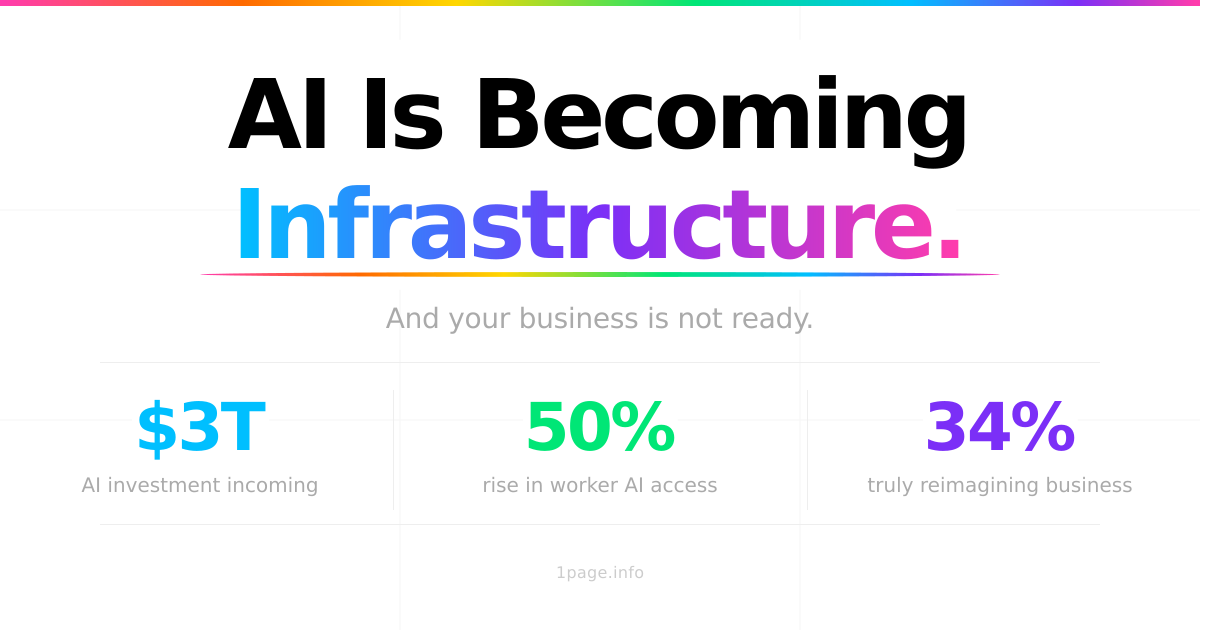
The numbers make this impossible to ignore. Morgan Stanley estimates that nearly $3 trillion of AI-related infrastructure investment will flow through the global economy by 2028, with more than 80% of that spending still ahead. Microsoft alone has committed $80 billion to AI-enabled data centers in fiscal 2026 — the largest infrastructure investment in the company's history. This isn't product development. This is foundation-building. And it's happening right now, with or without your business.
What "Infrastructure" Actually Means
When we call something infrastructure, we mean it becomes invisible — so embedded in how work gets done that you stop thinking of it as a tool and start thinking of it as the floor beneath everything else. Electricity. The internet. Cloud computing. Each followed the same arc: novelty, then advantage, then necessity.
AI is on that arc right now — and it's moving faster than any transition before it.
Worker access to AI rose by 50% in 2025, and the number of companies with 40% or more of their AI projects in production is set to double in the next six months. Meanwhile, just 34% of business leaders are truly reimagining their business around AI — the rest are bolting it on top of old workflows and wondering why the ROI isn't showing up.
That gap is the danger zone.
The Three Shifts Happening Right Now
The businesses winning with AI in 2026 understand three things their competitors don't yet.
AI is moving from tool to workflow. The question is no longer "should we use AI?" It's "which parts of our operation does AI not touch yet — and why?" 42% of companies say optimizing AI workflows and production cycles is their top spending priority in 2026. The focus has moved from trying AI to scaling it.
Compute is now a competitive resource. Infrastructure owners can now shape pricing, access, and product survival. Businesses that depend entirely on third-party AI tools without understanding the underlying compute landscape are exposed to vendor risk, pricing shifts, and capability gaps they can't control.
The skills gap is the real bottleneck. The AI skills gap is now seen as the biggest barrier to integration — and most companies responded with education rather than workflow redesign. That's the wrong fix. You don't train your team to use a hammer better. You redesign the process so fewer nails need hammering.
What Small and Mid-Sized Businesses Should Do Now
You don't need to spend billions. But you do need a position.
Start by auditing your core workflows — customer service, content creation, sales outreach, data reporting — and ask honestly: which of these could AI handle, partially or fully, right now? Not in theory. Right now, with tools that already exist.
Then build around outcomes, not tools. The businesses getting real ROI from AI aren't chasing the newest model — they're deeply integrating AI into one or two workflows and compounding the returns over time.
Two-thirds of organizations are already reporting productivity and efficiency gains from enterprise AI adoption. The ones not seeing results are the ones still treating AI as an experiment rather than an operating layer.
The Window Is Closing
Distribution beats novelty. A model can be smart and still lose if another tool owns the workflow, bundle, or default channel. The same logic applies to your business. The company that builds AI into its foundation now won't just be more efficient — it will be structurally different from competitors who waited.
The internet didn't wait for businesses to feel ready. Neither will AI.
The question isn't whether AI becomes infrastructure in your industry. It's whether your business is part of that infrastructure — or running on someone else's.
We are no longer in the era of AI experiments. We are in the era of AI infrastructure.
The numbers make this impossible to ignore. Morgan Stanley estimates that nearly $3 trillion of AI-related infrastructure investment will flow through the global economy by 2028, with more than 80% of that spending still ahead. Microsoft alone has committed $80 billion to AI-enabled data centers in fiscal 2026 — the largest infrastructure investment in the company's history. This isn't product development. This is foundation-building. And it's happening right now, with or without your business.
What "Infrastructure" Actually Means
When we call something infrastructure, we mean it becomes invisible — so embedded in how work gets done that you stop thinking of it as a tool and start thinking of it as the floor beneath everything else. Electricity. The internet. Cloud computing. Each followed the same arc: novelty, then advantage, then necessity.
AI is on that arc right now — and it's moving faster than any transition before it.
Worker access to AI rose by 50% in 2025, and the number of companies with 40% or more of their AI projects in production is set to double in the next six months. Meanwhile, just 34% of business leaders are truly reimagining their business around AI — the rest are bolting it on top of old workflows and wondering why the ROI isn't showing up.
That gap is the danger zone.
The Three Shifts Happening Right Now
The businesses winning with AI in 2026 understand three things their competitors don't yet.
AI is moving from tool to workflow. The question is no longer "should we use AI?" It's "which parts of our operation does AI not touch yet — and why?" 42% of companies say optimizing AI workflows and production cycles is their top spending priority in 2026. The focus has moved from trying AI to scaling it.
Compute is now a competitive resource. Infrastructure owners can now shape pricing, access, and product survival. Businesses that depend entirely on third-party AI tools without understanding the underlying compute landscape are exposed to vendor risk, pricing shifts, and capability gaps they can't control.
The skills gap is the real bottleneck. The AI skills gap is now seen as the biggest barrier to integration — and most companies responded with education rather than workflow redesign. That's the wrong fix. You don't train your team to use a hammer better. You redesign the process so fewer nails need hammering.
What Small and Mid-Sized Businesses Should Do Now
You don't need to spend billions. But you do need a position.
Start by auditing your core workflows — customer service, content creation, sales outreach, data reporting — and ask honestly: which of these could AI handle, partially or fully, right now? Not in theory. Right now, with tools that already exist.
Then build around outcomes, not tools. The businesses getting real ROI from AI aren't chasing the newest model — they're deeply integrating AI into one or two workflows and compounding the returns over time.
Two-thirds of organizations are already reporting productivity and efficiency gains from enterprise AI adoption. The ones not seeing results are the ones still treating AI as an experiment rather than an operating layer.
The Window Is Closing
Distribution beats novelty. A model can be smart and still lose if another tool owns the workflow, bundle, or default channel. The same logic applies to your business. The company that builds AI into its foundation now won't just be more efficient — it will be structurally different from competitors who waited.
The internet didn't wait for businesses to feel ready. Neither will AI.
The question isn't whether AI becomes infrastructure in your industry. It's whether your business is part of that infrastructure — or running on someone else's.
Written by
Divyansh Chandra
Content contributor at 1page.info. Sharing knowledge and insights about industries, digital trends, and business strategies.