

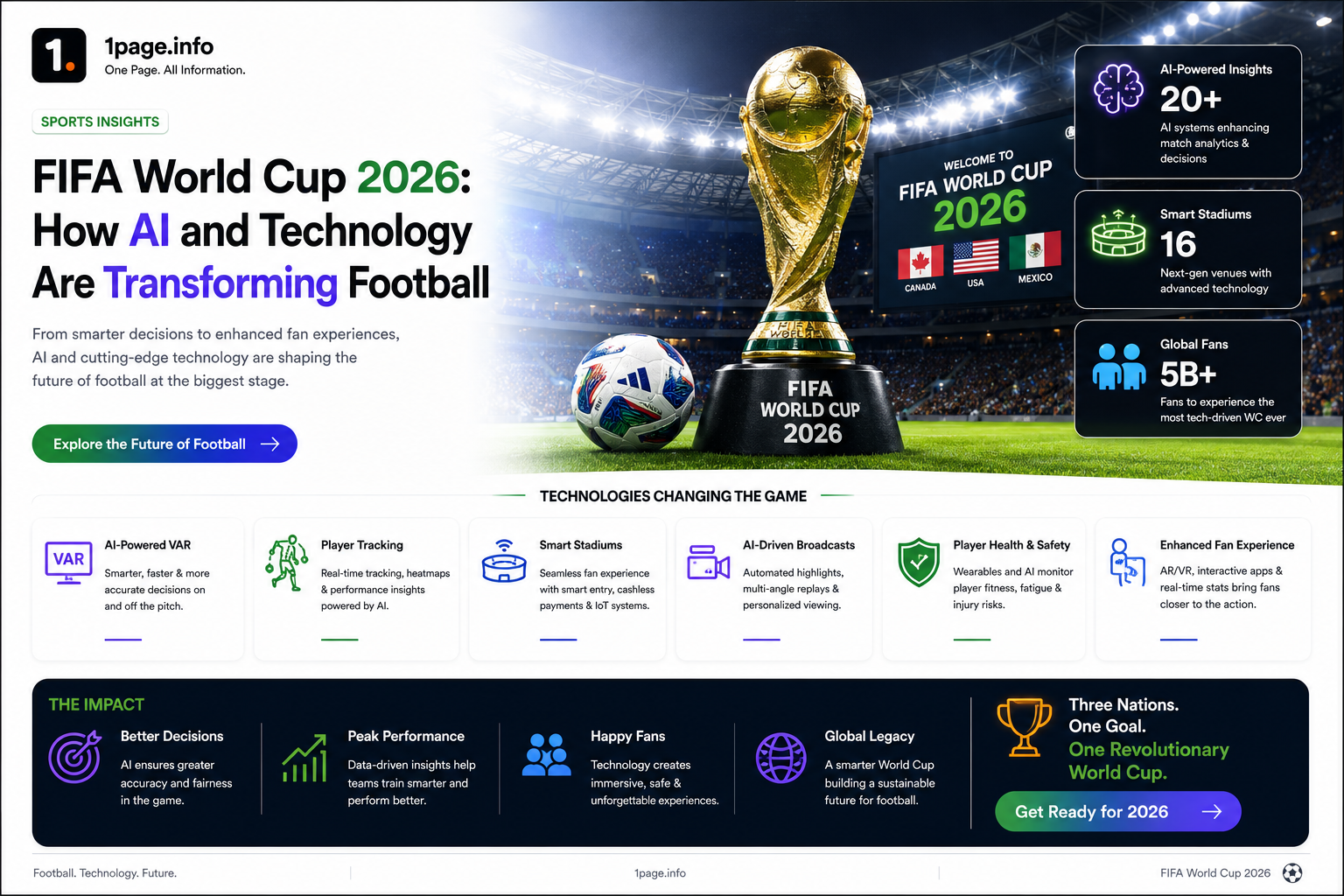
The FIFA World Cup has always been a place where the best football players in the world show their skills. The 2026 version showed that technology is becoming just as important as the players who are on the field. The event took place in the United States, Canada and Mexico. It brought in a new set of artificial intelligence tools and smart devices that made the games more fair, quicker and more exciting for people all over the world. There were AI tools that helped with calls and there were match balls that were connected to the system and there was better communication, for the referees. The 2026 FIFA World Cup showed how new ideas are changing the way the game is played while still keeping the excitement and the competition that makes the game special. One of the biggest technological advancements during the tournament was FIFA's upgraded Semi-Automated Offside Technology (SAOT). Instead of relying solely on manual VAR reviews, AI analyzed player positioning in real time using multiple tracking cameras, skeletal tracking, and sensors embedded inside the official match ball. This significantly reduced the time required to make offside decisions while improving accuracy. The connected ball transmitted data hundreds of times per second, allowing officials to identify the exact moment a player touched the ball. Combined with AI-powered player tracking, referees received quicker alerts, reducing lengthy interruptions and keeping the game flowing. Video Assistant Referee (VAR) technology also received major upgrades. AI tools now helped officials review incidents more efficiently by automatically identifying key moments, generating precise offside graphics, and assisting with decision-making. Goal-line technology, already familiar to fans, continued to instantly confirm whether the ball had crossed the line. New referee cameras and microphones also gave broadcasters unique perspectives, increasing transparency and allowing viewers to better understand important decisions. Although technology cannot replace human judgment entirely, it has become an essential support system for referees, helping reduce controversial decisions while maintaining fairness. The official match ball became one of the tournament's smartest pieces of equipment. Equipped with an internal motion sensor, it continuously transmitted data about ball movement and player contact. This innovation not only improved offside detection but also helped match officials identify subtle touches that might otherwise go unnoticed. Combined with AI systems, the connected ball provided an additional layer of precision that was previously impossible. Artificial intelligence was not just used for refereeing. National teams also used intelligence to look at the other teams they were playing against to see how their own players were doing and to come up with better plans for the games. The people who studied player performance looked at a lot of information including how players passed the ball how they moved on the field how hard they tried to get the ball and how good their shots were. Coaches used this information to get ready for the games and to make decisions. The companies that worked with FIFA also made artificial intelligence tools that helped all the teams, not the rich ones have a better chance to win by giving them the same access, to advanced analysis of the games. Technology also enhanced the fan experience throughout the tournament. Stadiums offered improved digital services, mobile ticketing, faster security systems, multilingual assistance, and real-time match information. Broadcasters used AI-generated graphics, player statistics, tactical visualizations, and referee-view cameras to provide viewers with deeper insights during live matches. Fans watching from home could better understand tactical changes, player positioning, and officiating decisions. These innovations made football more interactive without taking away the excitement that makes the sport so popular worldwide. Despite widespread praise, the increased use of technology also sparked debate. Some fans argued that constant technological intervention could reduce spontaneous celebrations or interrupt the emotional flow of matches. However, FIFA officials emphasized that AI is designed to assist rather than replace referees. Human officials continue to make the final decisions, while technology provides faster and more accurate information to support them. Finding the right balance between innovation and the traditional spirit of football will remain one of the sport's biggest challenges in the coming years. The FIFA World Cup 2026 showed that artificial intelligence has become a part of football. From balls and AI help with the game to better ways of looking at how players do and making fans more interested technology is changing almost everything about the game. As artificial intelligence keeps getting better the next tournaments are going to have smarter tools that make the game fairer keep players safer help with how teams play and make watching the game more fun. Even though the love, talent and surprise of football will always be there technology is making sure the biggest sports event, in the world keeps changing with the time. FIFA Innovation – Semi-Automated Offside Technology FIFA Innovation – Connected Ball Technology FIFA World Cup 2026 Technology Updates Business Insider – World Cup Technology Report Axios – The World Cup's AI AssistAI Makes Offside Decisions Faster and More Accurate
Smarter VAR Improves Match Officiating
Connected Ball Technology Changes the Game
AI Supports Teams Beyond the Pitch
Better Experiences for Fans
Balancing Innovation with Tradition
The Future of Football Is Intelligent
References
The FIFA World Cup 2026 showcased how artificial intelligence and advanced technology are transforming football. From AI-assisted offside decisions to connected match balls and smarter VAR systems, innovation is making the game fairer, faster, and more engaging for players, officials, and fans alike.