On May 19, 2026, Google made 100 announcements in two days. Most businesses missed it entirely. Here are the 5 changes that directly affect your website traffic — and the actions you need to take right now.
Most Google updates are incremental. A tweak to the algorithm here, a new ad format there. Google I/O 2026 was not that.
Google I/O 2026 wasn't a set of feature announcements. It was Google laying out the architecture of how search, content discovery, and online commerce will work from here. The headline from CEO Sundar Pichai: "We're firmly in our agentic Gemini era." What that means in plain English is this: Google is no longer just a search engine. It is becoming a system that thinks, acts, books, and buys on behalf of your customers — often without them ever visiting your website. PromptLayer
Here are the five changes every business owner and marketer needs to understand right now.
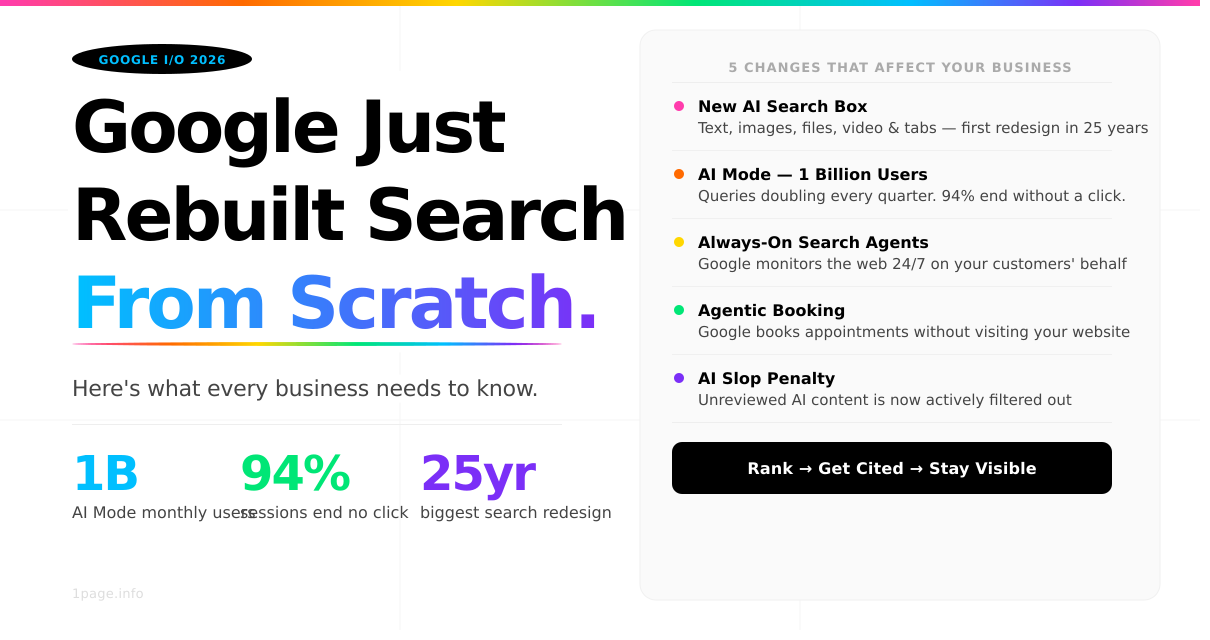
1. The Search Box Was Rebuilt for the First Time in 25 Years
Google's new AI-powered search box supports longer queries, AI-powered suggestions, follow-up questions, and inputs across text, images, files, videos, and Chrome tabs. This is not cosmetic. It fundamentally changes how your customers begin a search. They are no longer typing two-word queries. They are having full conversations with Google, uploading files, sharing screenshots, and asking layered follow-up questions — all in one session. Your content needs to answer real, complex, conversational questions, not just match keywords.
2. AI Mode Hit 1 Billion Monthly Users — and Queries Are Doubling Every Quarter
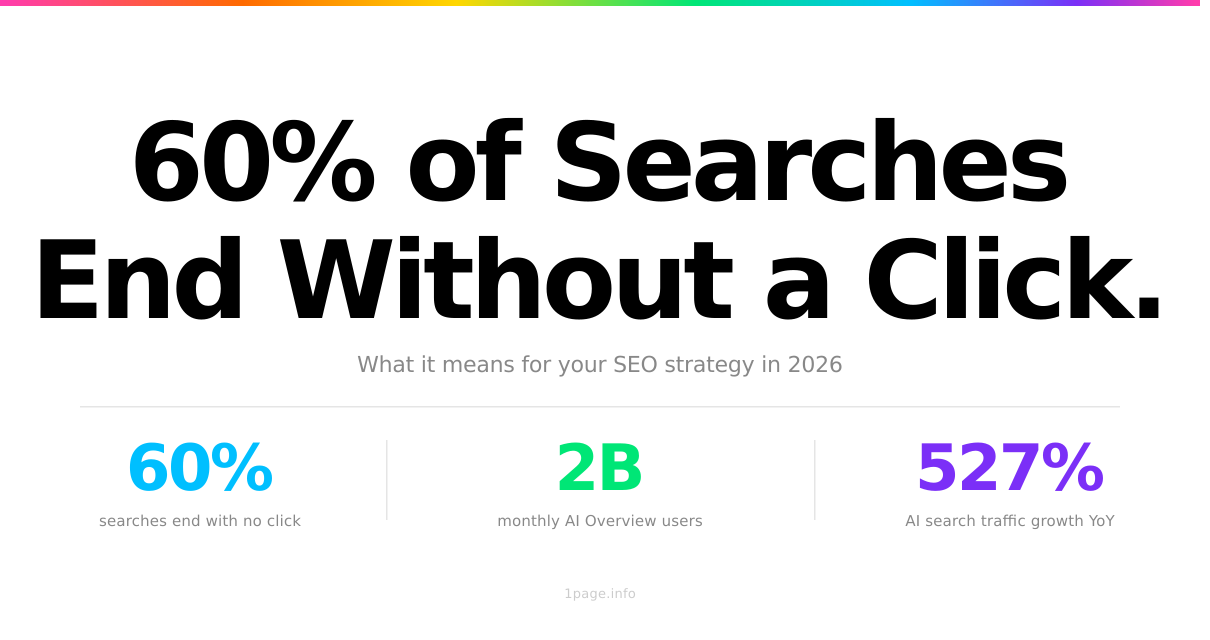
Google confirmed AI Mode has passed 1 billion monthly users and queries have more than doubled every quarter since launch. Inside AI Mode, 92–94% of interactions end without a click. That means billions of search sessions where your content may be read, summarised, and used — but your website never gets a visit. The goal is no longer just to rank. It is to be cited inside the AI answer itself.
3. Google Launched Always-On Search Agents
This is the announcement most businesses missed entirely. Information agents mean search becomes partially passive. Users define once what they're interested in, and Google searches permanently on their behalf — apartment hunting, sneaker drops, market changes in an industry. Information agents continuously search and synthesise updates, raising the question of whether your content is cited or overlooked in those summaries. For SEO, this is a structural shift. Your content now needs to be fresh, updated regularly, and consistently credible — not just optimised for a single moment in time.
4. Google Can Now Book Appointments Without Visiting Your Website
Agentic booking has expanded to local services, enabling Google to book appointments without a website visit. For local businesses, this is the most immediately impactful announcement from I/O 2026. Agent-driven booking relies on data signals the agent can access: Google Business Profile information, review ratings, structured availability data, and booking API integrations. Businesses without these data layers accessible to Google's systems will simply not be considered by agentic search — regardless of how good their website is. If your Google Business Profile is incomplete, you are now invisible to a growing portion of local search traffic.
5. AI Slop Is Now Being Actively Penalised
Flooding the web with AI content to game the system was never a sustainable strategy, and what Google announced is part of the infrastructure being built to identify and discount it. Brands that have been using AI indiscriminately, without oversight, review workflows, or any real editorial judgment, are going to feel that. Google's new content verification systems — SynthID and C2PA Content Credentials — are now rolling out across Search and Chrome. AI-generated content without human oversight, original insight, or real expertise is being filtered out at scale.
What You Should Do This Week
Audit your content distribution. If you are only publishing to your website, you are invisible to the agents Google just launched. Get serious about LinkedIn, YouTube, and the trade publications your buyers actually read. Run a citability audit on your top landing pages — ask whether each page contains a clear, independent position that an AI system would want to reference. Complete and verify your Google Business Profile. And if your content strategy is still built around keyword volume alone, it is time to rebuild it around questions, authority, and structured information.
Google I/O 2026 did not end SEO. It confirmed something more practical: search is becoming agentic, multimodal, and task-oriented, which means websites must become easier for machines to understand, compare, and act on.
The fundamentals still matter. They just have a higher bar now.
Google I/O 2026 wasn't a set of feature announcements. It was Google laying out the architecture of how search, content discovery, and online commerce will work from here. The headline from CEO Sundar Pichai: "We're firmly in our agentic Gemini era." What that means in plain English is this: Google is no longer just a search engine. It is becoming a system that thinks, acts, books, and buys on behalf of your customers — often without them ever visiting your website. PromptLayer
Here are the five changes every business owner and marketer needs to understand right now.
1. The Search Box Was Rebuilt for the First Time in 25 Years
Google's new AI-powered search box supports longer queries, AI-powered suggestions, follow-up questions, and inputs across text, images, files, videos, and Chrome tabs. This is not cosmetic. It fundamentally changes how your customers begin a search. They are no longer typing two-word queries. They are having full conversations with Google, uploading files, sharing screenshots, and asking layered follow-up questions — all in one session. Your content needs to answer real, complex, conversational questions, not just match keywords.
2. AI Mode Hit 1 Billion Monthly Users — and Queries Are Doubling Every Quarter
Google confirmed AI Mode has passed 1 billion monthly users and queries have more than doubled every quarter since launch. Inside AI Mode, 92–94% of interactions end without a click. That means billions of search sessions where your content may be read, summarised, and used — but your website never gets a visit. The goal is no longer just to rank. It is to be cited inside the AI answer itself.
3. Google Launched Always-On Search Agents
This is the announcement most businesses missed entirely. Information agents mean search becomes partially passive. Users define once what they're interested in, and Google searches permanently on their behalf — apartment hunting, sneaker drops, market changes in an industry. Information agents continuously search and synthesise updates, raising the question of whether your content is cited or overlooked in those summaries. For SEO, this is a structural shift. Your content now needs to be fresh, updated regularly, and consistently credible — not just optimised for a single moment in time.
4. Google Can Now Book Appointments Without Visiting Your Website
Agentic booking has expanded to local services, enabling Google to book appointments without a website visit. For local businesses, this is the most immediately impactful announcement from I/O 2026. Agent-driven booking relies on data signals the agent can access: Google Business Profile information, review ratings, structured availability data, and booking API integrations. Businesses without these data layers accessible to Google's systems will simply not be considered by agentic search — regardless of how good their website is. If your Google Business Profile is incomplete, you are now invisible to a growing portion of local search traffic.
5. AI Slop Is Now Being Actively Penalised
Flooding the web with AI content to game the system was never a sustainable strategy, and what Google announced is part of the infrastructure being built to identify and discount it. Brands that have been using AI indiscriminately, without oversight, review workflows, or any real editorial judgment, are going to feel that. Google's new content verification systems — SynthID and C2PA Content Credentials — are now rolling out across Search and Chrome. AI-generated content without human oversight, original insight, or real expertise is being filtered out at scale.
What You Should Do This Week
Audit your content distribution. If you are only publishing to your website, you are invisible to the agents Google just launched. Get serious about LinkedIn, YouTube, and the trade publications your buyers actually read. Run a citability audit on your top landing pages — ask whether each page contains a clear, independent position that an AI system would want to reference. Complete and verify your Google Business Profile. And if your content strategy is still built around keyword volume alone, it is time to rebuild it around questions, authority, and structured information.
Google I/O 2026 did not end SEO. It confirmed something more practical: search is becoming agentic, multimodal, and task-oriented, which means websites must become easier for machines to understand, compare, and act on.
The fundamentals still matter. They just have a higher bar now.
Written by
Divyansh Chandra
Content contributor at 1page.info. Sharing knowledge and insights about industries, digital trends, and business strategies.