

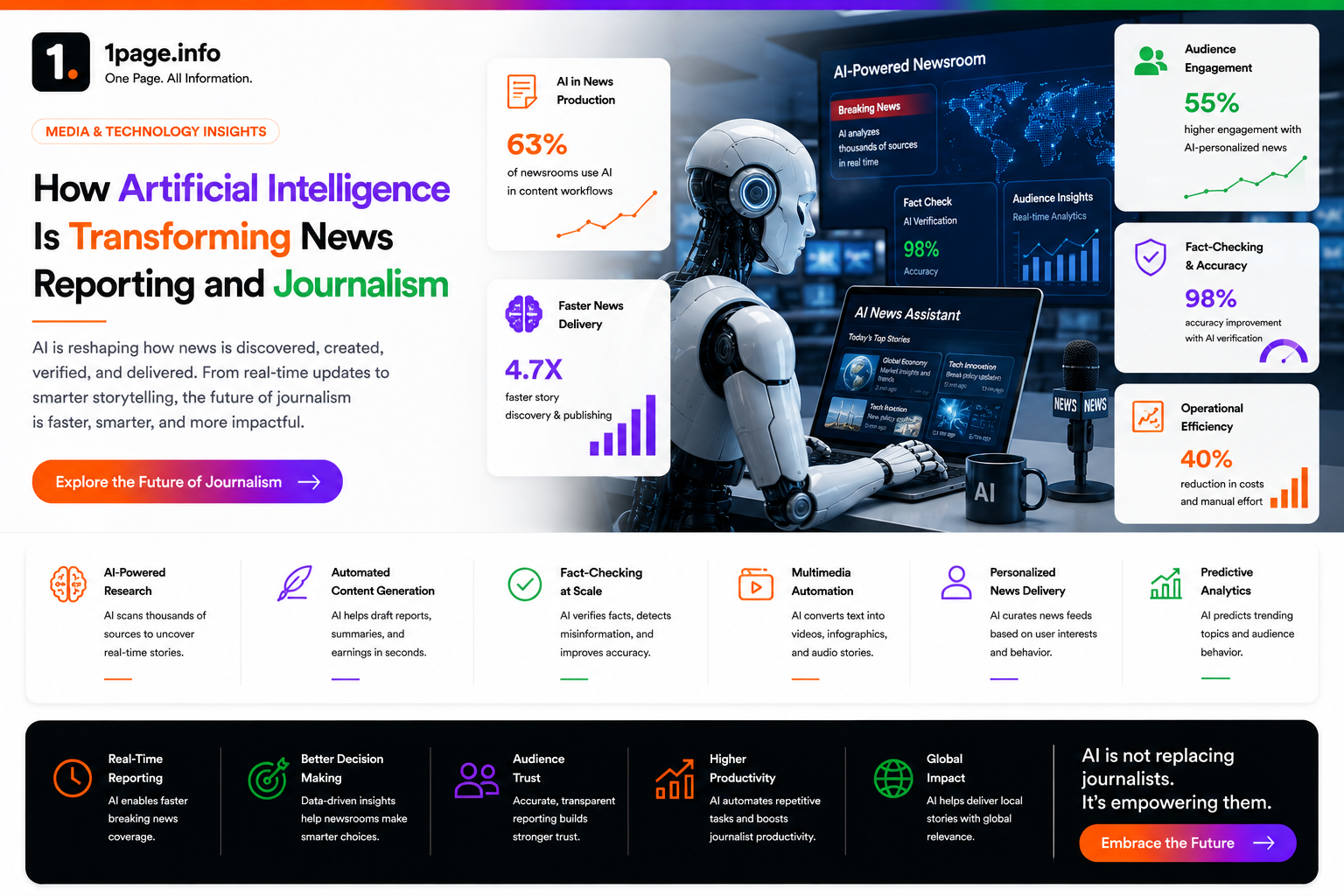
Artificial Intelligence (AI) is quickly changing the media world altering the way news is collected created, made and seen. In 2026 AI has become a must-have for news companies helping reporters work better and allowing people to get news that's quicker more tailored and more interesting. From robot writing and instant checking of facts to translating in languages and looking at who is reading the news AI is changing how news is made today.
Even though AI is not taking the place of reporters it is helping news teams spend time on deep research detailed stories and making choices about what to publish by handling the same tasks over and over. As media groups keep moving towards ways of working AI is becoming a main reason, for how responsible news will look in the future.
AI-Powered News Gathering
Modern newsrooms receive an overwhelming amount of information every day from government announcements, social media platforms, public records, press releases, and eyewitness reports. AI-powered tools help journalists monitor these sources in real time, identify emerging trends, and detect breaking news much faster than traditional manual methods.
Machine learning algorithms can analyze millions of online posts, identify unusual activity, and alert journalists to developing stories before they gain widespread attention. This allows news organizations to respond quickly while maintaining editorial oversight.
Automated News Writing
One of the most visible applications of AI is automated journalism. AI systems can generate news articles for data-driven topics such as financial reports, election results, weather updates, sports scores, and market summaries within seconds.
These automated reports are based on structured data and free journalists from routine reporting tasks, allowing them to spend more time on investigative stories, interviews, and complex issues that require human judgment and analysis.
Editors continue to review AI-generated content to ensure accuracy, clarity, and compliance with editorial standards.
Faster Fact-Checking and Misinformation Detection
The spread of information is a big problem for journalists today. Artificial Intelligence is helping to find information before a lot of people see it.
Artificial Intelligence tools can check what people say against things we know are true check pictures and videos to see if they are real find media that has been tampered with and identify content that looks real. These systems help journalists check their facts faster and reduce the chance of publishing information.
Even though Artificial Intelligence makes checking facts human editors are still in charge of making the final decision, about what gets published.
Personalized News Experiences
Today's audiences expect content tailored to their interests. AI-driven recommendation engines analyze reading habits, preferred topics, geographic location, and user engagement to deliver personalized news feeds.
Readers interested in business, technology, sports, politics, or entertainment receive customized content that matches their preferences. News organizations also use AI to recommend related articles, podcasts, videos, and newsletters, improving user engagement and retention.
Personalization helps readers discover relevant stories while encouraging longer interaction with digital news platforms.
AI Enhances Multimedia Journalism
Journalism is not about writing articles anymore. Now we have machines that help news people make videos and podcasts and other things like subtitles and voiceovers and pictures that move. These things help people understand news stories.
Machines can automatically write down what people say in interviews, which's really helpful.. There are tools that use machines to edit videos, which makes it faster to get the news out and easier for people to get to it. This means news people can make lots of kinds of content and get it out to people on lots of different platforms.
People are getting their news on their phones and on media more and more so journalism is using more videos and pictures and things, like that to tell stories. Multimedia storytelling is a part of digital journalism now. Journalism and multimedia storytelling are helping people get the news in ways.
Breaking Language Barriers
AI-powered translation tools are helping news organizations reach global audiences by publishing content in multiple languages almost instantly.
International news can now be translated quickly while preserving context and readability, making important information accessible to people across different regions. Multilingual publishing also enables local news organizations to expand their reach beyond traditional audiences.
Human editors continue to review translated content to ensure cultural accuracy and linguistic quality.
Data Analytics Improves Editorial Decisions
AI provides valuable insights into audience behavior through advanced analytics.
Editors can monitor reading time, engagement rates, click-through performance, subscription growth, and content preferences to better understand what readers value. These insights help publishers refine content strategies while balancing audience interests with public-service journalism.
Rather than relying solely on page views, many organizations now use AI-driven analytics to measure meaningful engagement and long-term reader loyalty.
Ethical Challenges of AI in Journalism
Despite its benefits AI also brings up important questions about ethics.
News companies need to make sure they are open when they use content made by AI. They should not let unfair patterns in the algorithms affect their stories. Keeping user information safe staying independent in their decisions and making it clear when a story was helped by AI or done by people are all very important for keeping the trust of the public.
Using AI in a way is now a main focus for media groups all over the world as they create rules, for using AI in an ethical way.
The Future of AI in Newsrooms
The role of AI in journalism will continue to expand over the coming years. Future developments may include intelligent research assistants, predictive news analysis, automated multilingual broadcasting, immersive storytelling through augmented reality, and AI-powered audience interaction.
However, the core values of journalism—accuracy, fairness, accountability, and editorial integrity—will continue to depend on experienced journalists who provide context, critical thinking, and ethical judgment.
AI will increasingly serve as a powerful assistant rather than a replacement for professional reporting.
Conclusion
Artificial Intelligence is changing the way news is reported and journalism is done. It is making newsrooms faster and smarter. Newsrooms can now work efficiently.
Artificial Intelligence is helping with things like automated reporting and fact-checking in time. It is also helping with content and publishing in many languages. Artificial Intelligence is even helping with producing multimedia content.
All these things are helping media organizations give people what they want in this age.
There are still some problems with Artificial Intelligence. People are worried about ethics and misinformation and transparency.
The future of journalism is all about using new technology and being responsible with the news. As Artificial Intelligence gets better it will be really helpful, to journalists. Artificial Intelligence will help journalists give people news that they can trust and that is interesting to read. Artificial Intelligence will help journalists do their job and give people around the world the news they need.
References
Reuters Institute for the Study of Journalism
World Economic Forum (WEF)
UNESCO
Press Information Bureau (PIB)
International News Media Association (INMA)