
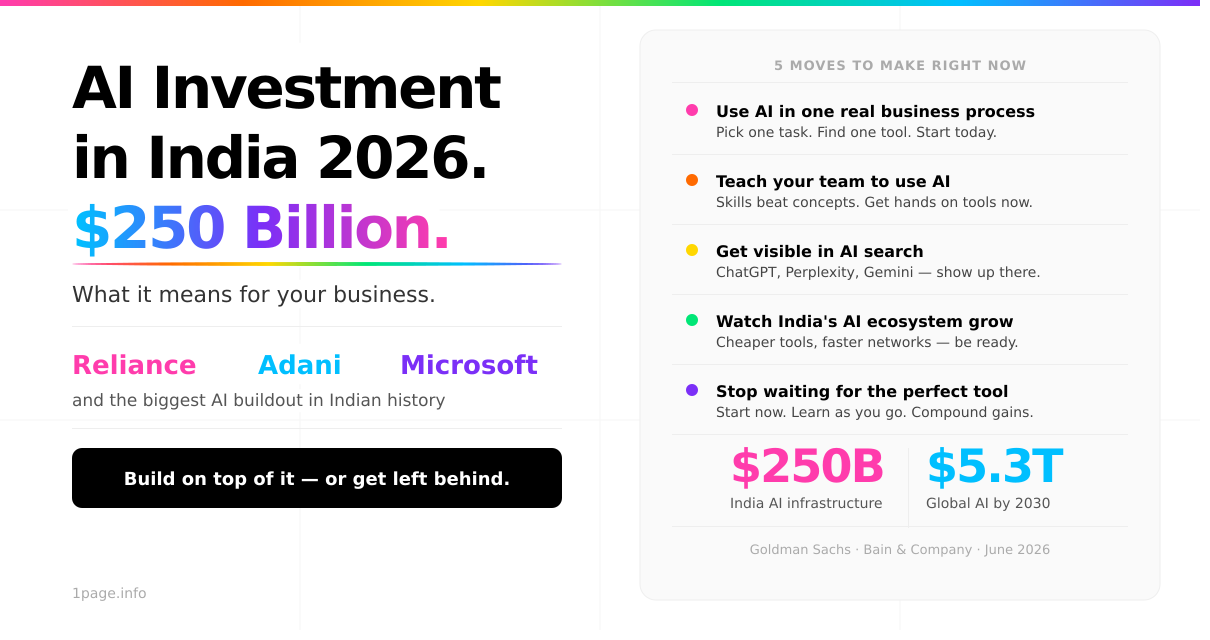
Right now, history's being made in India, but most business owners aren't getting in on it. At the India AI Impact Summit 2026 in New Delhi, big announcements flew left and right. Over $250 billion in AI infrastructure pledges were dropped. Reliance Industries led with $110 billion, the Adani Group promised $100 billion for data centers run on green power, and Microsoft added $50 billion to boost AI throughout the Global South.
That's not even considering India. A Goldman Sachs research note in June 2026 says that Meta, Microsoft, Amazon, and Google's Alphabet plan to spend $5.3 trillion by 2030 on AI infrastructure, data centers, and computing power. They'll pump this money into their operations, up from an earlier prediction of $4.5 trillion.
That $5.3 trillion investment is huge — it's more than Japan's GDP, and bigger than India's too. It's the biggest tech investment collaboration in history.
Why India Is at the Center of the Global AI Race?
India's big role in AI didn't happen by accident. In 2025, they became the top spot for generative AI app downloads, seeing a huge 207% yearly increase and beating the US even more. With 1.4 billion people, the biggest youth workforce in the world, and a fast-growing digital economy, India isn't just using AI; they're making it too.
OpenAI opened offices in Bengaluru and Mumbai. Anthropic announced its first Indian office in Bengaluru too. Plus, at the India AI Impact Summit, companies like Microsoft, Google, Nvidia, and Cloudflare made bigger partnership plans known. So, there's big tech growth happening in India.
What the $250 Billion Infrastructure Push Actually Builds?
When Reliance and Adani pledge $110 billion and $100 billion respectively to AI infrastructure, they're mostly building data centers — those buildings full of servers and GPUs that run AI. They're also setting up fiber optic networks to move all that AI-generated data around. Plus, they're putting in renewable energy plants to power everything sustainably. Finally, they're investing in people through universities, training programs, and research labs to keep these systems up and running.
Indian businesses plan to boost IT spending by 6–8% in 2026, outpacing the global forecast of 4–6%. Around 40–45% of their tech budgets will fund AI and data-focused makeovers, boosting digital evolution.
In plain terms, AI in India is set to get way faster, cheaper, and more accessible. Current infrastructure developments will lower AI tool costs, boost service reliability, and give smaller businesses access to tech once reserved for big companies. So, more firms can benefit from advanced capabilities across various industries
What This Means for Your Business — By Industry?
The $250 billion infrastructure boost doesn't impact every business the same way. For finance and taxation firms, it means big benefits through AI. They'll get quicker, more affordable access to tools for automating compliance, spotting tax issues, and generating reports. Plus, these tools will help them expand their client base. A CA firm in Ahmedabad that adopts AI in 2026 could support three times as many clients just two years later, all without adding staff.
For healthcare businesses and clinics, improved AI infrastructure makes diagnostic tools and patient management systems more affordable, not just big hospital chains. Now, a multispeciality clinic in Pune can use AI-powered follow-up systems for a couple of thousand rupees a month. So, smaller clinics can afford these tools too.
AI infrastructure helps real estate folk with better tools now. It does things like qualify leads, create property descriptions, and offer virtual tours and market analysis – all common, not extra pricey, stuff in the biz now.
Education and training companies can offer personalized learning on a large scale thanks to AI. A tutoring business in Hyderabad can use it to figure out which kids are having trouble with certain topics, create tailored practice materials, and track progress automatically — all while avoiding extra hires.
For retail, food, and e-commerce firms, predicting inventory, forecasting demand, analyzing customer behavior, and personalizing marketing becomes way easier. They can do it with tiny budgets and without a data science team.
The 5 Moves Every Indian Business Should Make Right Now
India is seeing massive investment in AI infrastructure. However, most of that infrastructure will take years to become fully operational. The opportunity, though, is available right now. Businesses that start adapting today will have a significant advantage when this new AI ecosystem is fully built. Here are five practical steps every business should consider.
1. Use AI in One Real Business Process
Don't try to transform your entire business overnight.
Instead, pick one repetitive task—customer inquiries, lead management, report generation, content creation, or administrative work—and find an AI tool that can help you do it faster and more efficiently. You don't need perfection. You just need to start.
2. Teach Your Team How to Use AI
Understanding what AI is isn't enough. Knowing how to use it is what creates value.
Encourage your team to experiment with AI tools, learn practical use cases, and automate repetitive work wherever possible. The businesses that develop AI skills today will be better positioned for tomorrow.
3. Make Your Business Visible in AI Search
People aren't just using Google anymore.
Customers are increasingly asking questions on ChatGPT, Perplexity, Gemini, and other AI-powered search platforms before making decisions. If your business has little online content, outdated information, or a weak digital presence, AI systems are less likely to recommend you.
In the age of AI-generated answers, visibility is the new SEO.
4. Keep an Eye on India's Evolving AI Ecosystem
New data centers, cloud platforms, and AI infrastructure projects are being built across the country. You don't need to be a technology expert, but it's important to understand that AI tools will become faster, more powerful, and more affordable over the next few years. Businesses already using these tools will be in the best position to benefit from those improvements.
5. Don't Wait for the Perfect Tool
Many businesses delay adoption because they're waiting for the perfect AI solution.
The companies succeeding with AI today are not necessarily using the most advanced systems. They are using available tools consistently, learning as they go, and improving over time.
Small improvements made consistently often lead to major competitive advantages.
The Window Is Narrow
This isn't just another technology trend.
It's a major infrastructure shift—similar to the rise of electricity, telecommunications, or the internet. Businesses that adapt early typically gain the most. Those that wait often spend years trying to catch up.
India's AI infrastructure is being built whether your business is ready or not.