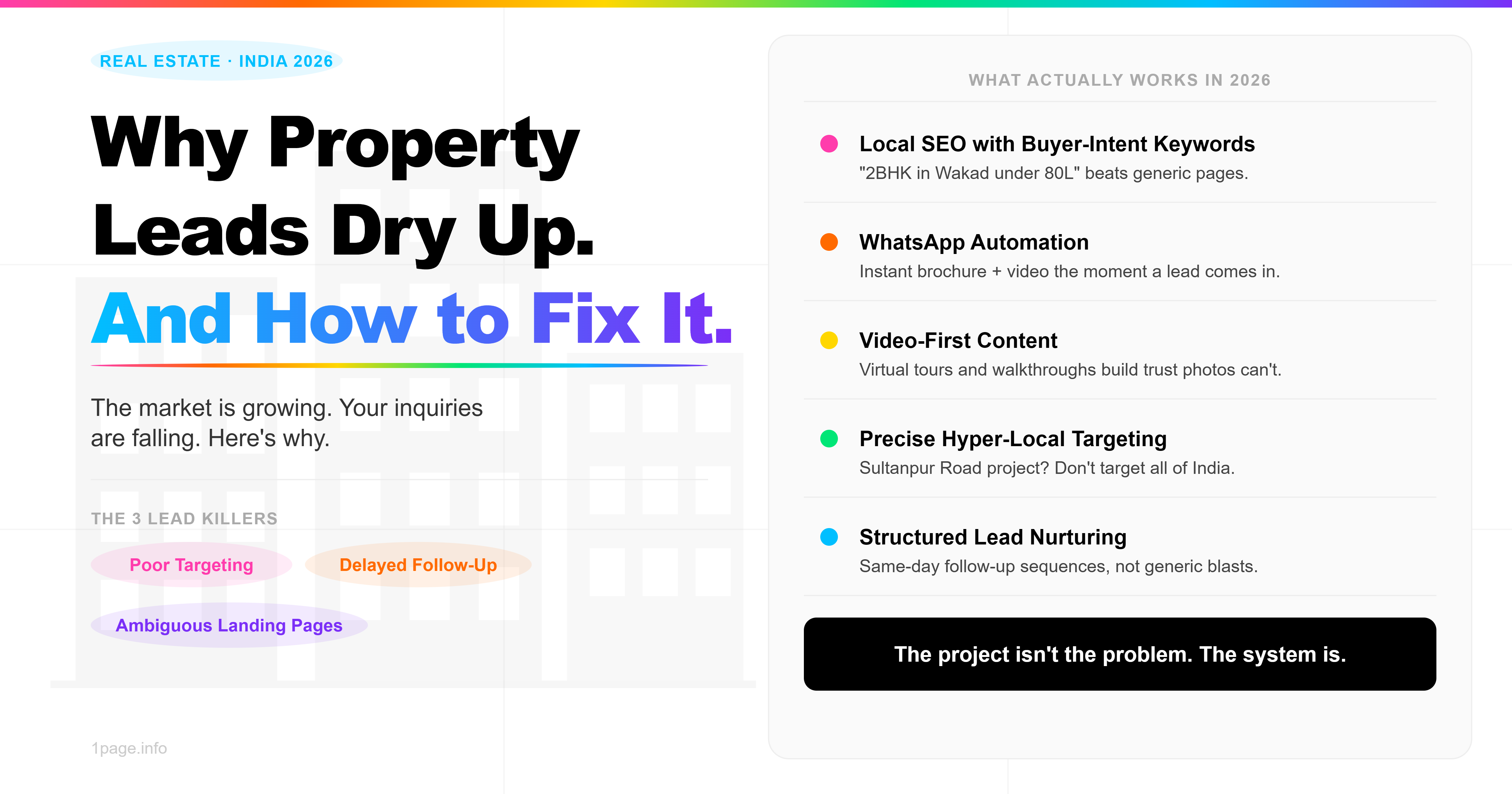
The Indian real estate market is booming with housing demand in Tier-1 and Tier-2 cities through the roof. New home launches in places like Mumbai, Pune, Bengaluru, Hyderabad, and Ahmedabad are increasing, but here’s the twist: lots of developers, builders, and agents are seeing fewer inquiries. This happens even as the market continues to grow all around them.
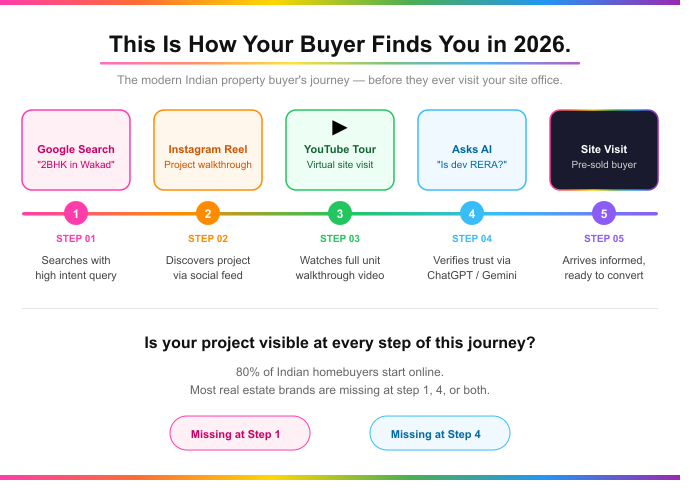
It's simple. Indian property buyers now find, research, and choose homes differently. Over 80% start online, and 91% of Gen Z gets info through social media. Also, 36% of city-dwelling Gen Z are house hunting. This means they discover properties in their feeds, not just on real estate sites.
If your real estate plan is still mainly about hoardings, newspaper ads, and broker referrals, you're almost invisible to the biggest buyer crowd in India. This group is growing super fast too. So here’s what a good digital marketing strategy for real estate looks like in 2026.
The Buyer Has Changed — Your Marketing Hasn't
First-time homebuyers in Pune now start with Google. They search for "2BHK flats in Wakad under 80 lakhs," watch video tours online, check Instagram and reviews, and even ask AI like ChatGPT if the developer’s legit before talking to anyone about homes.
These buyers are super switched on, very careful, and love their digital tools. They want quick answers and detailed, personalized advice. A developer that posts useful stuff—like info on RERA registration, when you can move in, and what the area’s got—will win trust. This beats some other dev who only says “Text us for the best price.” Buyers now demand clear information and don’t hesitate to look elsewhere if they don’t get it.
The shift is from interruption marketing to intent marketing. Your digital presence needs to meet buyers where they already are, with the information they are already searching for.
SEO for real estate in 2026
This isn't about loading "flats in Mumbai" ten times on your site. The AI running search engines gets the context and meaning behind words now. With features like AI Mode and AI Overviews, Google is shaking up how sites rank and how people find businesses online. So, if you're sticking to old SEO tricks, your rankings will keep sinking.
For real estate developers and agents, it’s crucial to create content that answers the questions potential buyers type into searches or ask their AI assistants. A blog post like "Is Hinjewadi a good place to buy a flat in 2026?"—with specific, data-backed answers—will outperform a generic "Properties in Pune" landing page every time.
Some practical SEO actions for real estate businesses include creating neighborhood-specific landing pages for each micro-market. They should also publish helpful content about RERA, possession processes, and have EMI calculators on their site. Adding FAQ schema markup helps too, as it makes your info appear in Google’s AI answers. Lastly, make sure your Google Business Profile is completed, verified, and kept up to date with fresh photos and reviews.
Performance Marketing — Meta and Google Ads for Real Estate
Meta’s AI-driven Advantage+ campaigns now find recent real estate portal visitors and serve ads to them on Facebook and Instagram. For instance, if you're launching a new place in Ahmedabad, you could zero in on people who checked out MagicBricks or Housing.com in the past month. It gets even better; these campaigns can target individuals aged 28 to 45, living less than 20 km from the project area, and looking into home loans.
Back then, small and mid-sized builders didn’t have access to such precise targeting. Luckily, today, it's easy — all it takes is the right setup and a monthly budget between ₹20,000 and ₹50,000.
When it comes to Google Ads, real estate firms need to go after high-intent, location-specific keyword searches rather than general awareness campaigns. Examples include “3BHK flats in Whitefield Bengaluru,” “affordable apartments Navi Mumbai 2026,” and “RERA approved projects Noida.” By focusing on search terms like these, you hit potential buyers when they’re super close to making a decision.
Online Reputation Management – The Most Underestimated Real Estate Marketing Tool
Getting attention online is getting easier each year, but building trust isn't. In the real estate game, maintaining a good online reputation is key. In 2026, it's not just about having a great project; you need five-star reviews too.
This highlights how crucial reviews have become. Consider this: a developer with 4.2 stars out of 200 reviews will land more deals than one with 3.1 stars, even if the latter has a supposedly superior project. In India, top players know this. To succeed, you must control what's said about you online. Responding to complaints, boosting positivity – it's all essential now.
One case shows just how powerful this can be.
A Mumbai realtor made it a point to ask for Google Reviews after each client registration. Her efforts paid off huge. In half a year, her review count shot up from 11 to 94. Plus, she got a 40% spike in inquiries without spending extra on ads. It proves that managing your online talk really does move properties.
The Digital Marketing Agency Advantage for Real Estate
Juggling SEO, performance ads, social media, video production, and online reputation can be pretty tough. Most in-house real estate marketing teams just don’t have the expertise to handle all that. That's why having a trusted digital marketing agency on board is a must for growing your business in 2026.
Early adopters of these latest trends are seeing better results too.
It's not like a good agency just runs ads all day. They create an entire system where everything works together. For example, SEO helps people find you organically, while performance ads catch those with immediate buying intent. Videos build trust with potential clients, and managing your reputation turns that trust into actual inquiries.
Now, the real estate brands doing best in India aren't known for their biggest billboards. Success goes to those with the most dependable, credible, and easy-to-find digital setups. That's the kind of thing these agencies build for them.