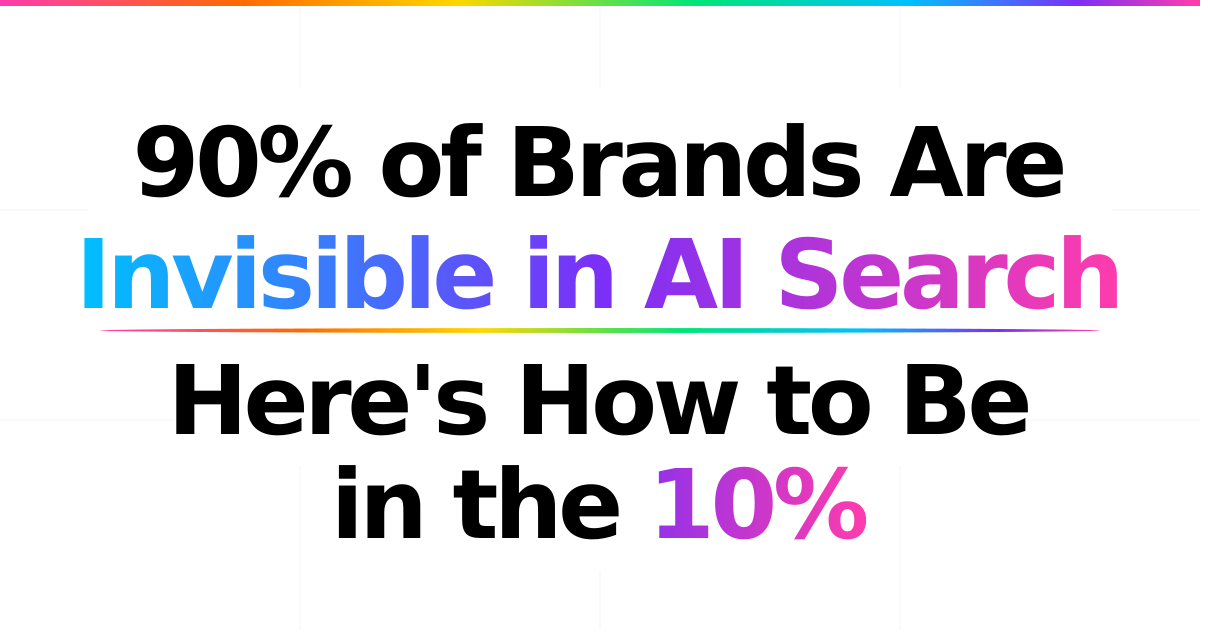
It has now been scientifically proven what most marketers have suspected but couldn’t admit – 9 out of 10 brands don’t even show up in AI search results. Not because they rank poorly. They don’t show up at all. This is what’s different about the top 10%.
Take a look at that statistic.
90% of all brands aren’t visible at all when it comes to artificial intelligence-based searches. Not showing up on page two. Not earning lower click-through rates. Invisible. If someone poses a question to an AI tool like ChatGPT, Perplexity, Gemini, or even Google's AI Mode, your brand isn't part of their response in any way.
The need for action couldn’t be more urgent either. Google's market share in search ads in the US will decline to under 50% by 2026 for the very first time ever in the history of digital advertising. Traffic is shifting. But where does your brand figure into that story?
How and Why Traditional SEO Isn’t Good Enough Anymore?
It’s an intrinsic issue. Up to 65-85% of ChatGPT prompt language is conversational, few correspond to traditional search language, and most are either navigational or transactional in nature. Nobody is typing “best CRM software 2026” into ChatGPT. They type, “I manage a sales team of ten people. Which CRM should I use and why?” These are fundamentally different prompts that call for fundamentally different content solutions.
Traditional SEO focuses on keywords. AI SEO focuses on answers. And if your content revolves around keywords, instead of being a complete answer to a question posed, then AI-based engines don’t have any reason to quote from you.
Here are five distinct traits of companies that appear in AI searches.
1. They Answer to Provide Solutions, Not To Rank
There is one crucial paradigm shift in content development in the world of artificial intelligence that can be identified. It is moving away from keyword content towards question-driven content. The engines provide an answer based on information gathered from multiple sites. Content that fails to provide the answer until it reaches the third paragraph does not make the cut. Content that provides the answer straightaway and adds relevant information to the answer makes it through.
Each time you develop content, you should be able to answer one question thoroughly.
2. They Actually Are The Authors
AI search is compiling the Internet's knowledge in ways that no other search engine ever has, which is resulting in entirely new behaviors and experiences for users. One such behavior is a high degree of trust in information that can be traced back to actual, credible, and identifiable individuals. Posts written anonymously by faceless "content teams" are being de-emphasized in favor of content produced by credible, named experts backed up by verified credentials, experience, and online presence. Every single item of content on your website must be created by someone with their name mentioned alongside a comprehensive author biography and credentials. It’s not an option for artificial intelligence; it’s a prerequisite.
3. They Offer Original Data and Specific Statistics
AI engines favor content that brings a new angle to the discussion. Original data and research, proprietary data and statistics with links to their sources, as well as unique case studies, get cited much more often compared to mere opinions and general statements.
If you write "many companies implement AI technology," an AI engine won't bother citing you. However, if you write "according to a June 2026 study, 90% of brands do not show up in the results of AI searches," this is an original data piece that should get cited.
4. They Mention Third-Party Brands Extensively
Your website alone won't help improve your AI search visibility. In fact, a recent study has shown that 30% of ChatGPT referral traffic goes to only 10 websites, while 20% of that traffic lands on Google directly, suggesting that AI engines highly prefer brands with comprehensive digital presence on multiple platforms.
All of these things add up to the brand signal that AI engines look for in deciding whether your brand should be cited. And if your brand doesn’t exist outside your website, then it does not exist in the eyes of AI-powered search engines at all.
5. They Format Their Content for Structured, Scanable Scanning by AI Engines
AI engines analyze content in bulk. They value well-formatted content, meaning well-structured headings, proper use of bullet points where needed, numbering for process descriptions, including FAQ sections, and schema markup. Good formatting for both readability by humans and scanning by AI increases the effectiveness of the content dramatically.
Include an FAQ in all of your major content pieces. Create a numbered process description for your how-tos. Include H2 and H3 headings as questions or as complete statements. This is not about good design; it’s about getting seen by AI.
The Time to Leverage AI for Your Search Strategy Is Now
Research revealed that 20% of referral traffic from ChatGPT leads to Google — growing from 14% in 2024 to more than 21% by January 2026. AI-based search is not replacing all of your traffic; it is directing traffic towards the companies already cited on their authority. That authority builds upon itself just like domain authority once did.
The brands that are the first to begin developing their search visibility on AI in the middle of 2026 will be the ones that the AI search engines default to from 2027 onwards. The brands that will choose to play second fiddle will suffer the same fate as those who chose not to jump onto Google Ads and Facebook Ads when they first appeared.
90% of the brands out there are currently invisible. This is not something to fear. This is simply an opportunity. And opportunities like this don't come around too often and tend not to last.
The problem is not about whether you should use AI for your brand. The problem is being among the first 10% before your competitors are.
According to a new report, 90% of brands are not showing up in search results using ChatGPT, Perplexity, and Google’s AI mode. Discover what makes up the top 10% and the 5 steps they take to ensure their brands show up in AI searches.
Written by
Divyansh Chandra
Content contributor at 1page.info. Sharing knowledge and insights about industries, digital trends, and business strategies.