
The advertising landscape in India just fundamentally shifted. Most brand leaders haven't noticed yet.
For fifteen years, Indian brands treated digital advertising as a simple formula: Google for search. Facebook for awareness. Amazon for e-commerce. That was the playbook. It was predictable. It worked.
Today, that formula is broken.
Blinkit, Zepto, and Swiggy Instamart are not just delivery platforms. They have become advertising platforms. And they're winning budget dollars that used to go to Google and Meta.
The Scale of the Shift
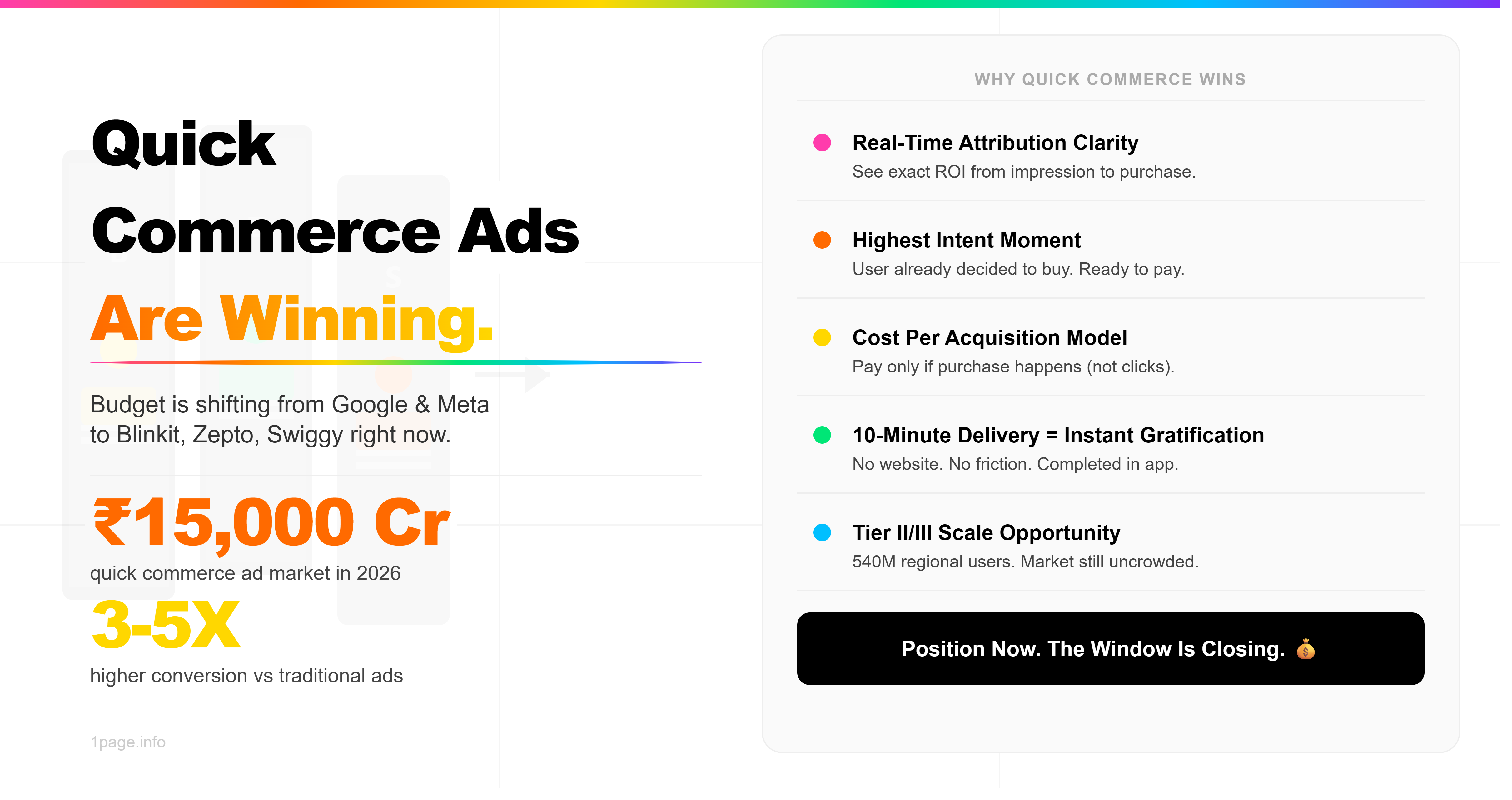
Here's what's actually happening: Quick commerce platforms now control a ₹15,000+ crore advertising opportunity in 2026. That's not venture-backed startup numbers. That's real, profitable advertising revenue competing directly with Google and Meta.
The mechanism is simple but powerful. A consumer opens Blinkit at 10:45 PM searching for "protein powder." Within seconds, they see sponsored listings from brands that paid for placement. If they click and buy, the transaction closes in 10 minutes.
Compare that to Google Ads. A consumer searches "protein powder." They click your ad. They go to your website. They browse. They abandon. They see a retargeting ad three days later. Maybe they buy. Maybe they don't.
Quick commerce collapses that entire funnel into one moment. Search. See ad. Buy. Done. All in one app.
For FMCG brands and D2C companies, this matters more than you think.
Why Quick Commerce Ads Are Stealing Budget
The fundamental reason quick commerce ads are winning is attribution.
When a brand runs Google Ads, they see impressions, clicks, conversion rates. But there's always ambiguity. Did the user convert because of the ad? Or did they already know the brand? How much credit does the ad actually deserve?
Quick commerce removes that ambiguity entirely.
A brand runs a sponsored product ad on Blinkit. They see: impressions, clicks, basket additions, checkouts, actual revenue. Real-time. Precise. No attribution mystery.
Marico did this with Saffola Oats. They ran sponsored product ads on Blinkit targeting breakfast-item searchers. They tracked the entire path from impression to checkout. They saw exact ROI at the SKU level. The campaign worked so well they reallocated budget from other channels.
This is not an anomaly. This is what's happening across D2C, FMCG, and e-commerce right now.
The Second Advantage: Intent is Immediate
Traditional advertising is about building awareness or intent. Quick commerce ads work on existing intent.
A user opens Blinkit because they want to buy something. Now. Not "someday." Now. They have their wallet open, delivery address entered, and payment method saved.
Your ad appears when this intent is highest. The friction is lowest.
Contrast this to Meta or Google Ads. A user scrolls Instagram. They see your ad. Sure, maybe they click. But they're not in "buying mode." They're in "scrolling mode." The mental shift from scrolling to buying takes effort.
Quick commerce ads exploit a moment when buying is already the user's objective. That's why conversion rates are 3-5X higher than traditional digital channels.
The Budget Reallocation Problem
Here's where it gets uncomfortable for brand leaders: quick commerce ad budgets are growing, but they're not entirely new money.
They're being taken from somewhere else.
A brand that spent ₹1 crore on Google Ads + ₹75 lakhs on Meta Ads last quarter is now spending ₹90 lakhs on Google + ₹60 lakhs on Meta + ₹50 lakhs on Blinkit Ads.
The total is up, but Google and Meta's share is down. And both platforms notice when budgets decline.
This matters because Google and Meta still own the awareness game. But if you don't capture demand on quick commerce when intent is high, you lose the customer entirely. Someone else's sponsored listing appears instead.
The Metric That Changed Everything
The single biggest shift in how brands think about advertising in 2026 is the move from "cost per click" to "cost per acquisition."
Google Ads charges per click. Meta charges per impression or per click. You pay whether the customer buys or not.
Quick commerce platforms are moving toward "cost per purchase" or "cost per basket add." You only pay if the action happens.
This completely changes how brands evaluate ad spend. Suddenly, a channel that seemed expensive (high CPM) becomes efficient (low CPA).
A brand running awareness campaigns on Meta might see a 0.5% conversion rate and accept it as normal. They run the same message on Blinkit and see 3% conversion. They reallocate budget immediately.
What Smart Brands Are Doing in 2026
The brands winning are not abandoning Google and Meta. They're restructuring their entire funnel.
Top of funnel (awareness): Meta, YouTube, CTV. Build broad awareness.
Mid-funnel (consideration): Google Search, YouTube, Pinterest. Capture people researching.
Bottom funnel (conversion): Quick commerce ads. Capture people ready to buy. Close the sale in 10 minutes.
This three-layer approach means:
- Meta's job is to make people aware of your brand
- Google's job is to capture people researching your category
- Quick commerce's job is to close the sale when intent is highest
Each channel has a different metric for success. Brands that try to measure quick commerce ads by "brand awareness" fail. Brands that measure it by "contribution to conversion" succeed.
The Attribution Mess (And How to Fix It)
Here's the problem: quick commerce ads look amazing in isolation. They show high conversion rates, clear ROI, and obvious causation.
But they don't account for the awareness work that Google and Meta did upstream.
A customer might see a Meta ad for your brand, then come back three days later and search for you on Blinkit. The quick commerce ad gets 100% of the conversion credit. But Meta created the awareness.
Smart brands are fixing this by building a unified attribution model that gives credit to the entire funnel, not just the final click.
Tools like Singular, AppsFlyer, and custom GA4 setups are helping brands understand: "What percentage of my quick commerce conversions would not have happened without my awareness spending on Meta?"
Once you have that answer, you can stop second-guessing your budget allocation.
The Competitive Edge
Here's what most brand leaders don't realize: the quick commerce advertising market is still new. The competition is not yet brutal.
A brand that masters quick commerce ads now — building the right attribution model, testing creative, understanding category seasonality — will have a structural advantage over competitors who are still "figuring it out."
In 2027, when every FMCG brand is competing on Blinkit and Zepto ads, CPCs will rise. Competition will intensify. The opportunity will shrink.
The window to build scale efficiently is narrow. It's this year and next.
The Bottom Line
Quick commerce advertising is not a trend. It's a structural shift in how Indian consumers discover and buy products, especially in Tier II and Tier III cities.
For D2C brands, FMCG companies, and e-commerce businesses, ignoring this channel is leaving conversion on the table. Your competitors are already there.
The brands that win in 2026-2027 are not the ones with the biggest overall ad budget. They're the ones who understand that different channels have different jobs in the customer journey.
And they're allocating budget accordingly.
If your brand is still running the same playbook from 2022 — all Google, mostly Meta — it's time to rethink.
The customer is on Blinkit at 10 PM. Your ad should be there