
Someone in Jaipur picks up their phone and says, "Hey Google, best dentist near me." Someone in Coimbatore asks Alexa, "Order basmati rice five kilos." Someone in Lucknow says, "Plumber near me, available today."
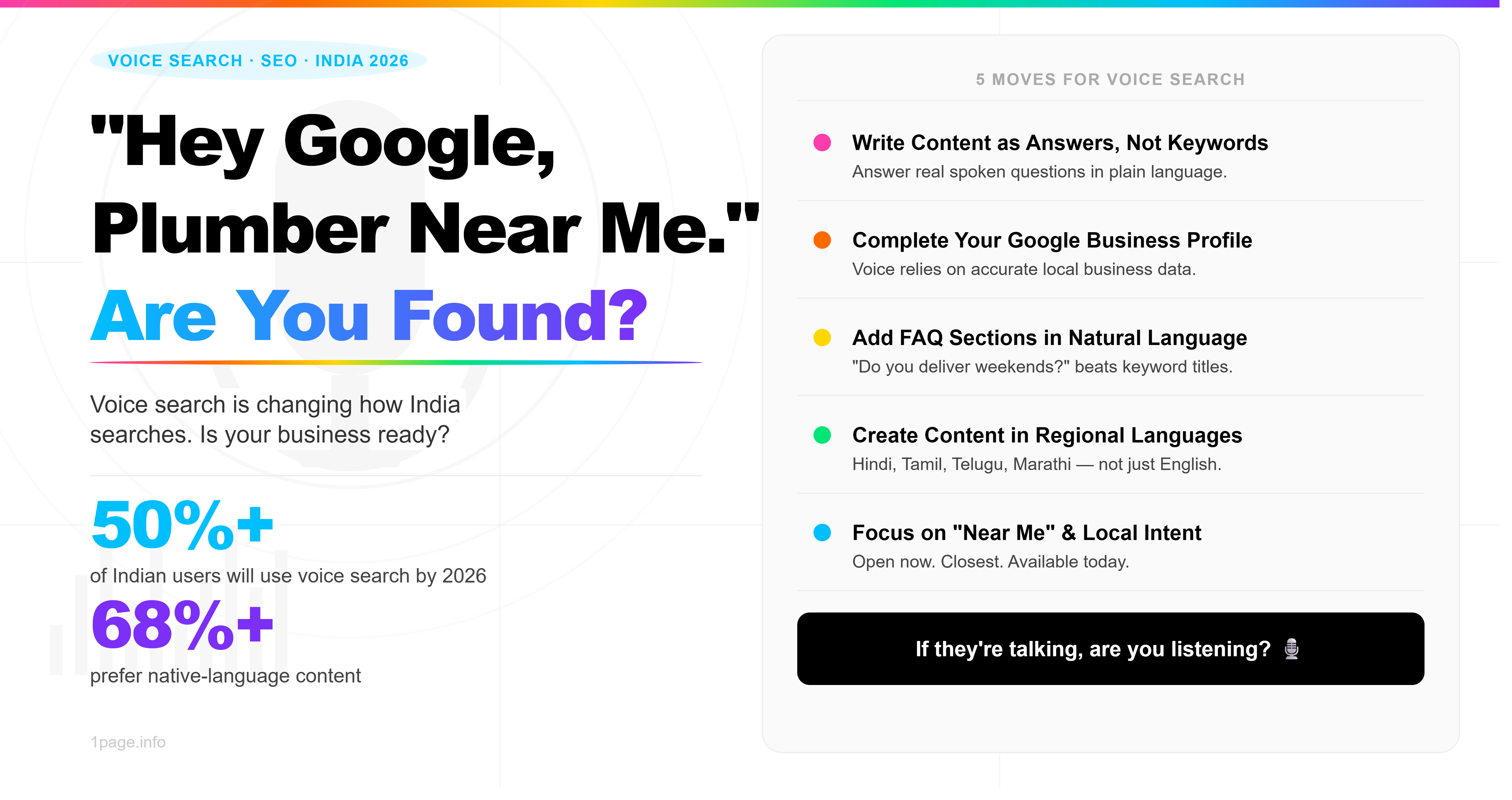
None of these are typed searches. None of them match the keywords most Indian businesses have spent years optimising for. And by the end of 2026, more than half of India's internet users will be searching this way regularly.
This is not a future trend. It is happening right now — and most businesses have no idea their entire SEO strategy is built for a search behaviour that is rapidly becoming secondary.
Why Voice Search Is Exploding in India
India's internet growth story has always been different from the West. Smartphones got cheaper before keyboards got easier. Regional languages got digital before English typing became second nature for hundreds of millions of users. Voice removes the friction that typing creates — especially for users who are more comfortable speaking than typing, and especially in regional languages.
Vernacular content platforms are now the default experience for a majority of Indian internet users, with native-language content preference already above two-thirds and climbing fast. When someone in Ahmedabad asks their phone a question in Gujarati, or someone in Chennai asks in Tamil, the businesses that show up are the ones whose content — and whose underlying data — can be understood and matched to that spoken, regional, conversational query.
If your business website is written entirely in formal English with keyword-stuffed phrases like "best plumber services Lucknow affordable rates," it is structurally mismatched with how a real person actually asks Google for help out loud.
How Voice Search Queries Are Different
Typed search and voice search are not the same search behaviour wearing different clothes. They are fundamentally different.
A typed search looks like: "plumber Lucknow rates." A voice search looks like: "who is a good plumber near me right now." A typed search looks like: "best dentist Bandra reviews." A voice search looks like: "which dentist near me is open today and takes new patients."
Voice queries are longer, more conversational, framed as full questions, and almost always carry local intent — "near me," "right now," "open today," "closest." If your content is built around short, clipped keyword phrases, it does not match the actual language a voice assistant is trying to understand and respond to.
What This Means for Your Business
The businesses that get found through voice search in 2026 are not the ones with the most keywords on their page. They are the ones whose content answers real questions, in natural language, with information structured in a way that voice assistants and AI search tools can extract and read aloud.
This changes what "good content" means for a business website. A page that says "We provide plumbing services in Lucknow at affordable rates" does not answer a voice query. A page that says "Need a plumber in Lucknow today? We offer same-day plumbing repairs across the city, including emergency callouts" directly answers the question someone is asking out loud.
5 Things Every Indian Business Should Do for Voice Search Right Now
Write content as answers to questions, not as keyword phrases. Every product or service page should directly answer a question a customer might ask out loud. "What is the best [service] in [city]?" "Is [your business] open right now?" "How much does [service] cost in [city]?" Structure your content so the answer is clear within the first sentence or two.
Complete and optimise your Google Business Profile. Voice search relies heavily on local business data — hours, location, phone number, services, and reviews. An incomplete or outdated Google Business Profile means a voice assistant simply cannot recommend your business, even if it is exactly what the user needs.
Add FAQ sections in natural, spoken language. A dedicated FAQ section with real questions — written the way customers actually ask them, not the way a business writes marketing copy — is one of the highest-impact additions for voice search visibility. "Do you deliver on weekends?" performs better for voice search than "Weekend Delivery Services Available."
Create content in regional languages, not just English. With native-language content preference continuing to rise across India, businesses that publish content in Hindi, Tamil, Telugu, Bengali, Marathi, Gujarati, and other regional languages are positioning themselves for the voice queries that are increasingly happening in those languages — not just English.
Focus on "near me" and local intent phrases. Voice search is dominated by local intent — "near me," "open now," "closest," "available today." Make sure your content, your Google Business Profile, and your location pages clearly state your service area, working hours, and immediate availability in plain language.
The Window Is Open
Most Indian businesses have not adjusted their content strategy for voice search at all. Their websites are still built around the typed-keyword logic of 2018. That gap is the opportunity.
The businesses that restructure their content around natural-language questions, complete their local business data, and publish in the languages their customers actually speak will be the businesses that get recommended when someone picks up their phone and asks for exactly what that business offers.
Voice search is not a feature to add later. It is becoming the way a growing share of India searches — and businesses that are not optimised for it are simply not part of the conversation happening on hundreds of millions of phones, every single day.