
India's automotive industry is in the middle of a transformation most people don't fully grasp.
By 2035, internal combustion engine vehicles will drop from 97% of India's automotive production to just 35%. Two-thirds of India's cars will be electric. Think about that for a second — within a decade, the industry's fundamental architecture changes.
For traditional OEMs, this is an existential challenge. For engineering services firms, it's the opportunity of a decade.
The Scale of the Shift
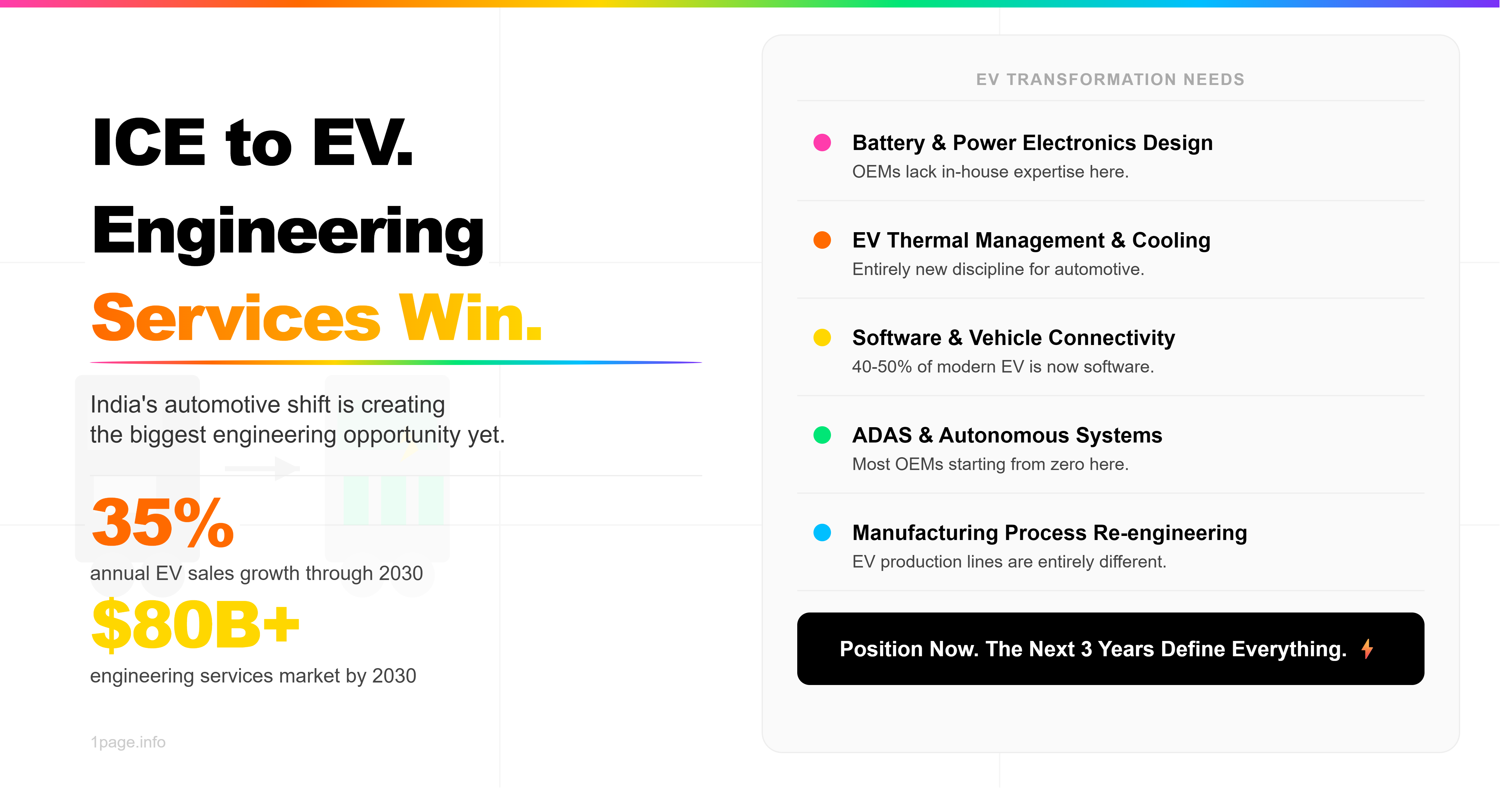
The numbers tell the story. India's EV sales are projected to grow at 35% annually through 2030. That's not gradual evolution. That's explosive transformation.
Simultaneously, India's engineering services market is expanding at 8.2% CAGR and projected to reach $254 billion by 2030. But that's the aggregate number. EV-focused engineering is growing 3-4X faster — at 25-30% annually.
The automotive sector alone spends $50 billion on product engineering services today. By 2026, that number is expected to reach $80 billion. India's auto component sector is projected to hit $200 billion by 2030.
This convergence of rapid EV adoption + massive engineering spend + global supply chain diversification creates the largest engineering opportunity in Indian automotive history.
Why OEMs Can't Do This Alone
Building an electric car is not just swapping an engine for a battery. It's reimagining nearly every system.
Battery architecture. Thermal management. Power electronics. High-voltage systems. Vehicle software. Autonomous driving features. Connectivity platforms. Manufacturing processes. Materials science.
A traditional automotive engineer spent their career understanding internal combustion. They know fuel systems, engine blocks, transmissions, exhaust. None of that applies to EVs.
Meanwhile, the software in a modern electric vehicle represents 40-50% of the vehicle's value. An ICE car's software was maybe 15-20%. OEMs built as mechanics, not software companies.
Here's what OEMs actually need right now:
Battery system design — thermal management, power electronics, safety systems, cell selection. This is a specialized discipline that took Tesla years to master.
Electric powertrain engineering — motor design, inverters, control systems, efficiency optimization. Most Indian OEMs are starting from zero here.
Software and connectivity — vehicle software architecture, over-the-air updates, autonomous features, sensor integration. This requires software engineers, not just mechanical engineers.
Thermal management — EVs generate different heat signatures than ICE vehicles. Cooling systems need complete redesign. Battery thermal management is a new discipline.
ADAS and autonomous systems — LiDAR integration, sensor fusion, real-time processing. Most OEMs lack internal capability here.
Manufacturing engineering — EV production lines are entirely different from ICE lines. Retooling, new fixtures, new assembly processes, battery pack integration.
This is not a single project. It's 500+ simultaneous projects happening across design, development, testing, and manufacturing. And most of it requires specialized expertise that traditional automotive engineering departments simply don't have.
The Market Opportunity
Here's where it gets real:
An OEM that spent 10% of their engineering budget on "new propulsion systems" in 2020 is now spending 40-50%. That reallocation is happening across every major Indian automotive company right now.
Engineering services firms with EV expertise are at full capacity. Many are turning away work because they can't hire engineers fast enough.
Firms without EV expertise are losing relevance. Their traditional ICE powertrain expertise is becoming commoditized.
The gap between "has EV capability" and "doesn't have EV capability" is widening every quarter. Firms on the right side of that gap are growing 2-3X faster than competitors on the wrong side.
Who Wins
Engineering services firms will win if they have:
EV thermal management expertise — This is the most specialized area where OEMs have virtually zero internal capability. A firm that can design battery thermal systems, cooling architecture, and thermal validation protocols has a moat.
Battery engineering capability — Battery management systems, cell characterization, thermal modeling, safety systems. Every OEM needs this. Very few firms have it.
Software and autonomous systems — Vehicle software architecture, over-the-air update infrastructure, ADAS algorithms, sensor fusion. This is where software engineers meet automotive.
System integration — Understanding how battery, motors, power electronics, software, and vehicle architecture all connect. This is harder than individual components.
Testing and validation — EVs require entirely new testing protocols. Temperature cycling, high-voltage safety, electromagnetic compatibility, autonomous system validation. New market, new expertise.
Manufacturing engineering — Helping OEMs retool production lines for EV assembly. Battery pack integration. New material handling. Process optimization for electric architectures.
The Global Supply Chain Angle
Here's the accelerant: geopolitical supply chain diversification.
Global automakers are moving away from concentrated EV hubs. India is increasingly positioned as a cost-competitive, high-skill centre for automotive engineering. Companies like Schaeffler are already investing in India's EV technology infrastructure.
But India only captures this opportunity if Indian engineering services firms can deliver advanced EV technology on time, on budget, and at cost. The firms that can will capture contracts not just from Indian OEMs, but from global manufacturers.
What Needs to Happen Now
If you're an engineering services firm, the timeline is critical.
Firms that invest in EV capabilities now — hiring specialized talent, setting up testing labs, building client relationships — will dominate 2027-2030. Firms that wait 18 months? They'll find themselves competing in a crowded market with lower margins.
Talent is the constraint. The electrical engineers, power electronics specialists, battery engineers, and software architects you need are globally in demand. You need to start recruiting now, not next year.
For OEMs and Tier 1 suppliers, the path is similar. You need internal engineering capability. But you also need to partner with specialized services firms that have gone deeper into specific domains than you can go internally.
The Bottom Line
India's automotive industry is not declining. It's transforming. The shift from ICE to EV is creating the largest engineering services opportunity in Indian automotive history.
Firms that understand this timing — that the window for positioning is narrow but real — and that invest accordingly will emerge from 2030 with multiples of their current size.
Firms that wait, that assume the market will shift gradually, that try to do everything in-house — they'll find themselves competing for leftover work in a commodity market.
The ICE era is ending. The EV era is beginning. And the engineering services industry in India is positioned to be one of the biggest beneficiaries of that transition.
The question is not whether this opportunity exists. It's whether you'll be ready to capture it when OEMs come looking for the expertise they can't build internally.