
India's startup story is no longer a Mumbai-Bangalore-Delhi story.
For years, if you wanted to build a startup in India, the conventional wisdom was simple — move to a major metro. Network with other founders. Get access to investor circles. Build in the cities where venture capital had money and where talent clusters existed.
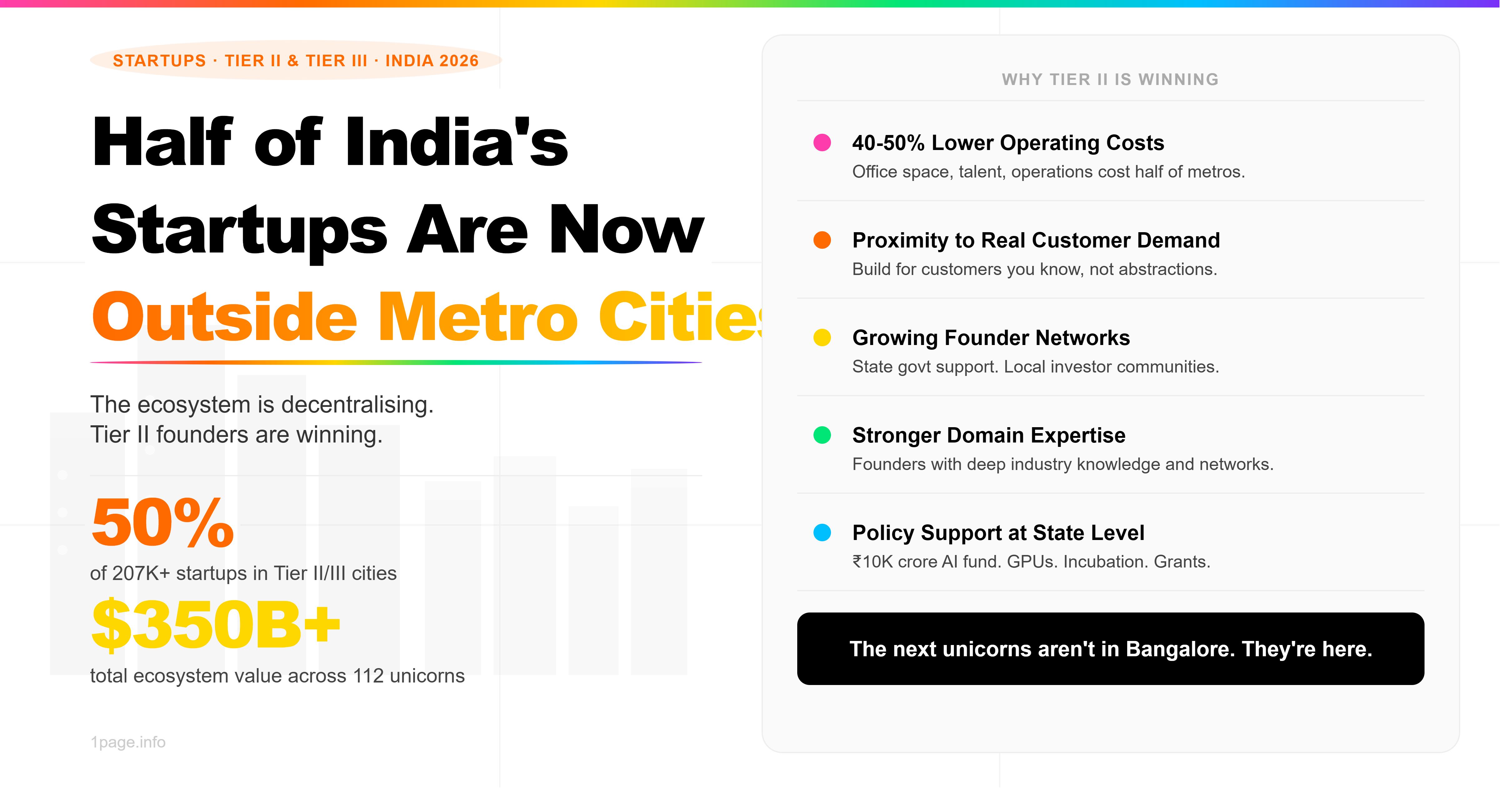
That story is changing fast. Nearly 50% of India's 207,000 recognised startups are now coming from Tier II and Tier III cities. With 112 unicorns valued at $350B+ collectively, and half of them built outside the top metros, the ecosystem has fundamentally shifted. And for most service providers, investors, and businesses serving startups, this shift has barely registered yet.
Why Tier II Cities Are Winning
The shift is not random. It is structural, driven by three clear advantages Tier II and Tier III cities now offer that metros cannot.
First, operating costs are dramatically lower. A startup in Tier II cities can rent office space, hire talent, and operate at 40-50% of metro costs — sometimes less. That matters enormously for founders bootstrapping or raising seed capital. Lower burn rate means longer runway. Longer runway means more time to find product-market fit without constantly chasing Series A funding.
Second, founders in these cities are closer to real market demand. A healthtech founder in a Tier II city is not building for abstract "India." They are building for the customers they interact with daily — hospitals, clinics, and patients in their own region. An agritech founder in a farming state builds for farmers they know, not farmers they read about in reports. This proximity to the customer problem you are solving is one of the strongest predictors of startup survival.
Third, non-metro founder networks are growing fast. Policy support from state governments — Karnataka's compute-as-a-service facility offering 2,000 GPUs, ₹10,000 crore in AI investments, and creation of 1.5 lakh jobs — is signalling that being outside metros no longer means being outside opportunity. Founder networks are forming in these regions. Investors are showing up. The infrastructure is being built.
What This Means for Businesses Serving Startups
The rise of non-metro startups is creating demand across multiple service categories that most service providers have not started positioning for.
Deeptech, healthtech, agritech, fintech, skilltech, and SME tools are the sectors seeing the strongest growth from Tier II and Tier III founders. These are not consumer apps. They solve urgent, specific problems — better cancer testing, faster EV adoption, cleaner energy, safer housing societies. And unlike consumer startups, these ventures have longer revenue timelines but higher survival rates once they find product-market fit.
A B2B software company serving startups in these sectors needs to understand that their customer is not raising $5 million Series A in a Sand Hill Road meeting. Their customer is bootstrapping, raising from family offices, or accessing state-backed funding programs. Pricing, onboarding complexity, and support models need to reflect that reality.
A recruiting or staffing business serving startups needs to understand that Tier II city startups are not poaching talent from metros. They are building local talent networks. An IIT graduate who would have moved to Bangalore five years ago might now stay in their home state because the startup ecosystem there is offering them founder equity, closer market proximity, and lower cost of living.
Service providers who position early — legal consulting for Tier II startups, accounting and compliance for non-metro founders, technical infrastructure for startups in secondary cities — are going to capture disproportionate share in the next 2-3 years, precisely because competition is still concentrated in the metros.
The Policy Tailwind
State governments have realised what venture capital figured out decades ago — startups are an economic multiplier. Job creation. Tax revenue. Export potential. And startups can be created anywhere if the infrastructure exists.
Karnataka's $1 billion AI fund, Tamil Nadu's semiconductor-focused startup support, and Gujarat's focus on deeptech are not random investments. They are signals that Tier II and Tier III cities are now competing for startup ecosystems at the state level.
For founders, this means access to grants, incubation support, and sometimes even customer pipelines (state governments often prefer to purchase from local startups). For service providers, it means that Tier II city startups have access to support structures that did not exist five years ago.
What Founders and Businesses Should Do Right Now
If you are a founder evaluating where to build, the calculus has shifted. Tier II cities now offer lower costs, closer customer proximity, and growing policy support — and the startup networks are forming now. Being early in these networks, before they become obvious to venture capital and big service providers, is genuinely an advantage.
If you are a business serving startups — recruiting, software, compliance, design, marketing — Tier II and Tier III cities represent white space. Most service providers are still concentrated in metros because that is where the money historically has been. But founder density is rising fast outside metros, and they have different needs than metro founders.
If you are an investor, the founder quality coming from non-metro cities is genuinely strong. Domain expertise — energy specialists, healthcare researchers, manufacturing engineers — is more common in Tier II cities than in metros. These founders often lack the polish and network of metro founders, but they have deeper domain knowledge and more direct customer relationships.
The Bigger Picture
India's startup ecosystem is not just growing — it is decentralising. The question is not whether Tier II and Tier III cities will matter. They already do, with half of India's recognised startups already there.
The question is whether the service providers, investors, and businesses serving this ecosystem will position for this shift before it becomes obvious to everyone else.