
The Indian healthcare landscape transformed in the last 18 months, and the transformation is not technological. It's behavioral.
In 2015, a patient looking for a doctor called a relative who knew someone. In 2020, they searched Google. In 2026, they open an app. They see ratings. They check telemedicine availability. They book a 10-minute consultation. They get prescribed medicine. Medicine arrives at home.
All without leaving their phone.
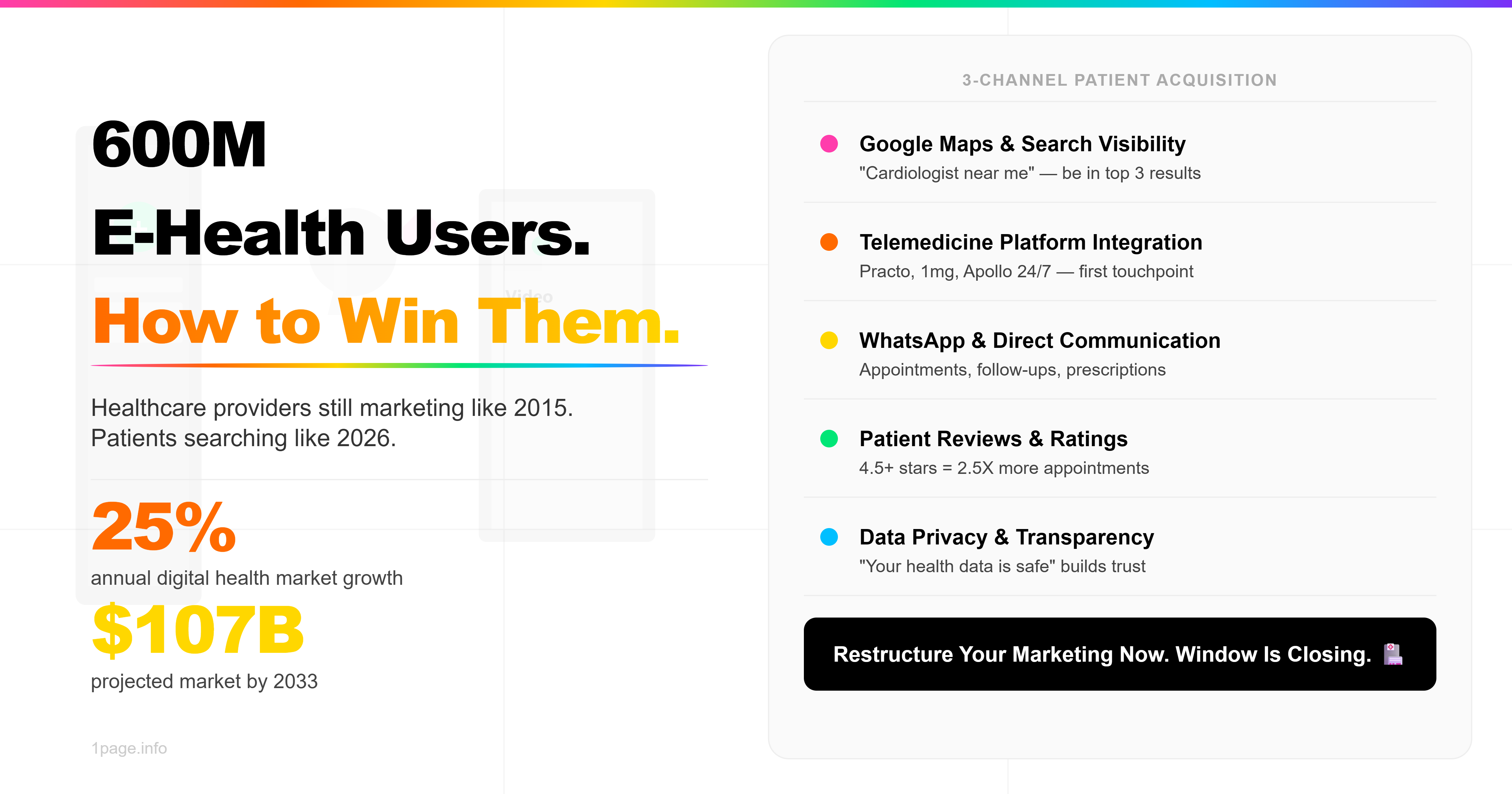
This shift from "visit a hospital" to "access healthcare" has created 600 million digital health users in India. The digital health market reached $14.50 billion in 2024 and is projected to hit $106.97 billion by 2033. That's 25% annual growth.
But here's what most healthcare providers are missing: the market is not just growing. It's fragmenting.
The Fragmentation Problem
For decades, hospital marketing was simple. Buy a billboard. Run newspaper ads. Get listed in local directories. Patients would find you because you were the only credible option.
Today, a patient in Bangalore searching for "cardiologist" sees Apollo, Fortis, Max, Manipal, plus a dozen telemedicine platforms, plus independent practitioners with online presence, plus Facebook pages, plus verified Practo listings, plus 1mg consults.
The choice is overwhelming. And overwhelming choice creates a new problem for healthcare providers: visibility fragmentation.
A hospital might have 50 beds, world-class doctors, and 30 years of reputation. But if they don't show up in Google Maps when someone searches "cardiac surgeon near me," they lose the patient. If they don't have WhatsApp integration for appointment booking, they lose the patient. If their website doesn't load on mobile, they lose the patient.
This is the new reality of healthcare marketing in 2026. It's not about being the biggest hospital anymore. It's about being visible where patients are searching.
The Three Channels Patients Are Using Now
Before understanding how to market, healthcare providers need to understand where patients are actually looking.
First: Google Maps and Search. A patient searches "diabetologist near me" or "maternity hospital in Indiranagar." They click the top three results. That's where they make their first decision. If your hospital is not on Google Maps or doesn't rank for location-based searches, you don't exist to these patients.
Second: Telemedicine Platforms. Practo, 1mg, Apollo 24/7, MediBuddy. Patients use these for first consultations because they're convenient. A doctor appointment in 10 minutes, without leaving home. For many telemedicine users, this is the default. If your hospital is not listed on major platforms or doesn't offer telemedicine integration, you're invisible.
Third: WhatsApp and Direct Message. After the initial consultation, patients use WhatsApp for follow-ups, prescriptions, and appointment rescheduling. Hospitals that built WhatsApp Business integration report 3-4X higher follow-up compliance compared to traditional phone calls. Why? Because patients already live on WhatsApp. Making them call a receptionist feels prehistoric.
Hospitals that win in 2026 operate across all three channels simultaneously. Patients search on Google, book on Practo, and communicate via WhatsApp.
The Patient Acquisition Funnel That Works
Smart healthcare providers are restructuring their entire patient journey around digital-first marketing.
Awareness Stage: Google Ads, content marketing, and social media. A patient searches "high blood pressure treatment" — you show up with helpful blog content about hypertension management. This builds trust before they even know who you are.
Consideration Stage: Google Maps, Practo, and hospital website. They've decided they need treatment. Now they're comparing options. Are you listed on Maps with ratings? Do you have verified credentials on Practo? Does your website answer their questions?
Decision Stage: WhatsApp, phone, or telemedicine booking. They're ready to book. Can they do it quickly? Can they confirm via WhatsApp? Do they have to call during business hours, or can they book 24/7?
Retention Stage: Follow-up via WhatsApp, patient apps, and digital prescriptions. After the consultation, do they get a digital prescription they can share? Can they access their health records? Can they book follow-ups without talking to a receptionist?
Hospitals optimizing each stage report 2-3X higher patient acquisition and 40% better retention compared to hospitals running traditional marketing.
The Telemedicine Inversion
Here's a counterintuitive insight: telemedicine is not cannibalizing in-patient healthcare. It's driving it.
A patient books a telemedicine consultation on Practo. The online doctor recommends they come in for advanced imaging. They visit the hospital. The hospital captures them into their system. Now that patient becomes a repeat customer for follow-ups, imaging, and in-patient care if needed.
Telemedicine is not replacing hospital visits. It's the first touchpoint that leads to hospital visits.
Hospitals that understood this are partnering aggressively with telemedicine platforms. Apollo partnered with Google Cloud to build Apollo 24/7. Practo integrated with 200+ hospitals. The strategy is clear: be visible in telemedicine, then convert to in-hospital care.
Hospitals not on telemedicine platforms are losing the first touchpoint entirely. They only see patients who already decided to visit in person — a much smaller segment.
The Local SEO Advantage
One of the biggest wins healthcare providers are seeing in 2026 is local SEO optimization.
A patient in Mumbai searches "orthopedic surgeon near me." Google shows three results on Maps. Those three positions capture 60-70% of all appointment bookings in that area.
Most hospitals don't optimize for this. They have websites, but their Google Maps listing is outdated. Their address is wrong. Their hours are old. They don't have photos of their facility. They haven't encouraged patients to leave reviews.
A hospital that invests in local SEO — accurate Maps listing, current hours, facility photos, responding to reviews, targeting location-based keywords — will capture 2-3X more appointments from local searches compared to hospitals that don't.
The Review Economy
In 2026, patient reviews are not optional. They're the primary trust signal.
A patient searches for a doctor. They see three options. All three have similar credentials. But one has 500 five-star reviews and the others have 20. Which do they choose?
Healthcare providers that systematically encourage patients to leave reviews (via SMS, WhatsApp, email after appointments) are seeing significantly higher conversion rates. Hospitals with ratings above 4.5 stars see 2.5X more appointment bookings compared to hospitals without reviews.
The mechanism is simple: after a successful consultation, patients are more likely to review. Make it easy (one-click review links) and you'll see review accumulation accelerate.
The Data Privacy Opportunity
One trend that surprised many: patients actually value privacy-first healthcare providers.
With ABDM (Ayushman Bharat Digital Mission) now assigning health IDs to 84+ crore Indians, data security became table stakes. Hospitals that transparently communicate how they protect patient data — "Your data is encrypted and never shared without your consent" — are winning patient trust.
This is not just about compliance. It's about marketing. In an era of data breaches, a hospital that can credibly claim "your health data is safe with us" has a competitive advantage.
What Needs to Happen Now
If you're a healthcare provider and you're still running the same marketing playbook from 2020, it's time to restructure.
Your marketing funnel should span: Google Search (awareness), Google Maps (consideration), Telemedicine Platforms (decision), and WhatsApp (retention).
Your website should load in under 2 seconds. Your appointment booking should be one-click. Your patient follow-ups should happen via WhatsApp, not phone calls.
Your Google Maps listing should have current hours, facility photos, and reviews. Your telemedicine integration should be seamless. Your patient data protection should be transparent.
This is not "nice to have." This is "necessary to compete" in 2026.
The Bottom Line
600 million Indians are now using digital health services. They search on Google. They book on Practo. They communicate via WhatsApp. They make decisions based on reviews.
Healthcare providers that understand this shifted behavior and restructure their entire patient acquisition and retention funnel will grow patient volumes by 2-3X compared to competitors still marketing like it's 2015.
The market opportunity is massive. The window to establish yourself as the digital-first health provider in your city is still open. But it's closing fast.
The hospitals that win in 2027 are the ones that are restructuring their marketing, operations, and patient experience around digital-first principles right now.
The question is not whether to digitalize. It's whether you'll do it before your competitors do.