
Meta Platforms announced it will lease an AI-enabled data centre in India with 168 megawatts of capacity from Reliance Industries, with Reliance building and delivering the facility within two years, and an option to scale further. The headlines focused on the size of the deal and what it means for Reliance and Meta.
What most coverage missed is what it means for everyone else.
Every hyperscale data centre that gets built in India creates a services economy around it — and that economy is where small and mid-sized IT businesses, system integrators, and managed service providers make their money. Not by selling servers to Meta. By serving the ecosystem that grows around facilities like this one.
India's Data Centre Boom Is Bigger Than One Deal
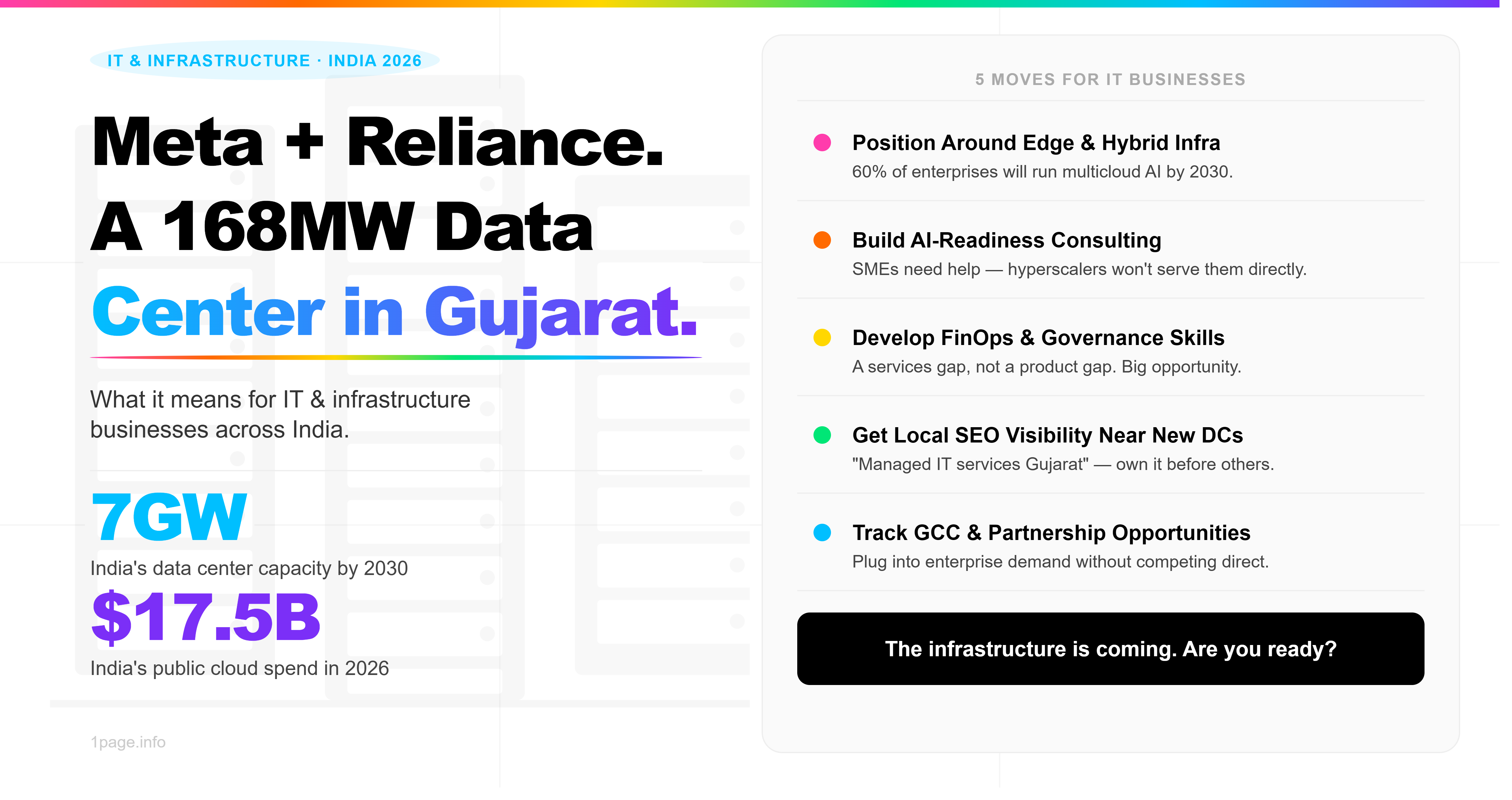
The Meta-Reliance announcement is one data point in a much larger trend. India's data centre capacity is expected to rise to 7 GW by 2030, with the country remaining cost-efficient compared to global alternatives. Mumbai already offers the second-lowest data centre construction cost worldwide.
India's IT spending is expected to reach $176.3 billion in 2026, driven significantly by data centre expansion and AI-enabled software investments. End-user spending on public cloud services in India is forecast to grow 28.1% to $17.5 billion in 2026, up from $13.7 billion in 2025 — with infrastructure-as-a-service projected to grow 40% this year alone.
This is not a one-time event. It is the early phase of a multi-year infrastructure buildout, and tens of billions of dollars are being invested in Indian data centre capacity through 2026 and beyond.
Why This Matters for IT & Infrastructure Businesses — Not Just Hyperscalers
The real opportunity in this buildout isn't in selling hardware to Meta or Reliance. It's in the long-tail services layer that forms around every major data centre — and that layer is where smaller IT businesses, MSPs, and system integrators actually compete and win.
Here's what that services layer looks like in practice. Every data centre needs local networking and connectivity partners for the businesses, campuses, and facilities around it. It creates demand for edge compute deployments — smaller, localised infrastructure that serves nearby businesses with lower latency. It drives demand for managed IT services from companies in the surrounding region who now have access to better connectivity and want to modernise their own infrastructure. And it creates demand for security integration, since rising data centre activity in a region typically accelerates local enterprise adoption of zero-trust security frameworks.
A new 168MW facility in Gujarat doesn't just employ people directly. It changes the digital infrastructure expectations of every business within driving distance — and most of those businesses will look for local partners, not hyperscaler sales teams, to help them adapt.
The Sustainability Angle Most IT Businesses Are Missing
Sustainability is now influencing IT buying decisions in India, with a significant share of organisations saying environmental impact is shaping their AI and infrastructure strategies. Data centres are adopting renewable energy sources, improving cooling efficiency, and optimising power consumption — and this shift is creating demand for green IT consulting, energy-efficient infrastructure audits, and sustainable cloud migration services.
IT businesses that can speak credibly about energy-efficient infrastructure, carbon-aware computing, and sustainable IT practices have a differentiator that most competitors in India haven't built yet. As large facilities like the Meta-Reliance data centre set sustainability benchmarks in a region, local businesses increasingly expect their own IT partners to meet similar standards.
What IT & Infrastructure Businesses Should Do Right Now
Position around edge and hybrid infrastructure. By 2030, over 60% of enterprises will perform intensive AI model activity in one cloud while leveraging it with data in another — up from less than 10% today. Businesses that can help clients navigate hybrid and multicloud setups, rather than pushing a single-platform solution, are positioned for where enterprise IT is heading.
Build local AI-readiness consulting services. The rising need for AI-ready infrastructure — GPUs, high-performance compute, high-speed networking, scalable storage — is creating demand that large enterprises are addressing internally, but small and mid-sized businesses cannot. An IT consultancy that helps a regional manufacturer or financial services firm assess and plan their AI-readiness journey fills a gap that hyperscalers don't serve directly.
Develop FinOps and governance expertise. Governance of increasingly complex hybrid, multicloud and AI-enabled environments is emerging as one of the most significant cloud challenges for enterprises in 2026. IT leaders need to shift from cloud adoption to disciplined execution — prioritising AI-ready data, stronger governance, FinOps maturity, and security-by-design. This is a services gap, not a product gap, and it's where consulting-led IT businesses can build long-term client relationships.
Get visible to the businesses near new infrastructure. As data centres get built across Gujarat, Maharashtra, and other states, the businesses operating near them will start looking for local IT partners who understand the changing digital landscape in their region. SEO content targeting location-specific terms — "managed IT services Gujarat," "cloud migration consultant Ahmedabad" — positions local providers to capture this demand before larger national players move in.
Track GCC and partnership opportunities. India's growth is increasingly driven by global capability centres, AI-led partnerships, and value-led service models. Smaller IT businesses that build relationships with GCCs setting up in their region — offering complementary services that GCCs don't want to build in-house — can plug into enterprise-scale demand without competing directly with Tier-1 IT giants.
The Bigger Picture
India's technology services sector can scale to $750–850 billion by 2035, and the country expects over $200 billion in AI investment over the next two years. The Meta-Reliance data centre is one visible marker of a much larger structural shift — and structural shifts create services opportunities long before they create headlines about who benefits.
The IT and infrastructure businesses that position themselves now — around edge computing, AI-readiness consulting, sustainability, and hybrid cloud governance — will be the ones capturing demand as this infrastructure comes online over the next two to three years. The ones who wait will be competing for the same opportunities once they've become obvious to everyone.
Meta and Reliance just signaled where the infrastructure is going. The question for every IT business in India is whether they're building the services that infrastructure will need.