
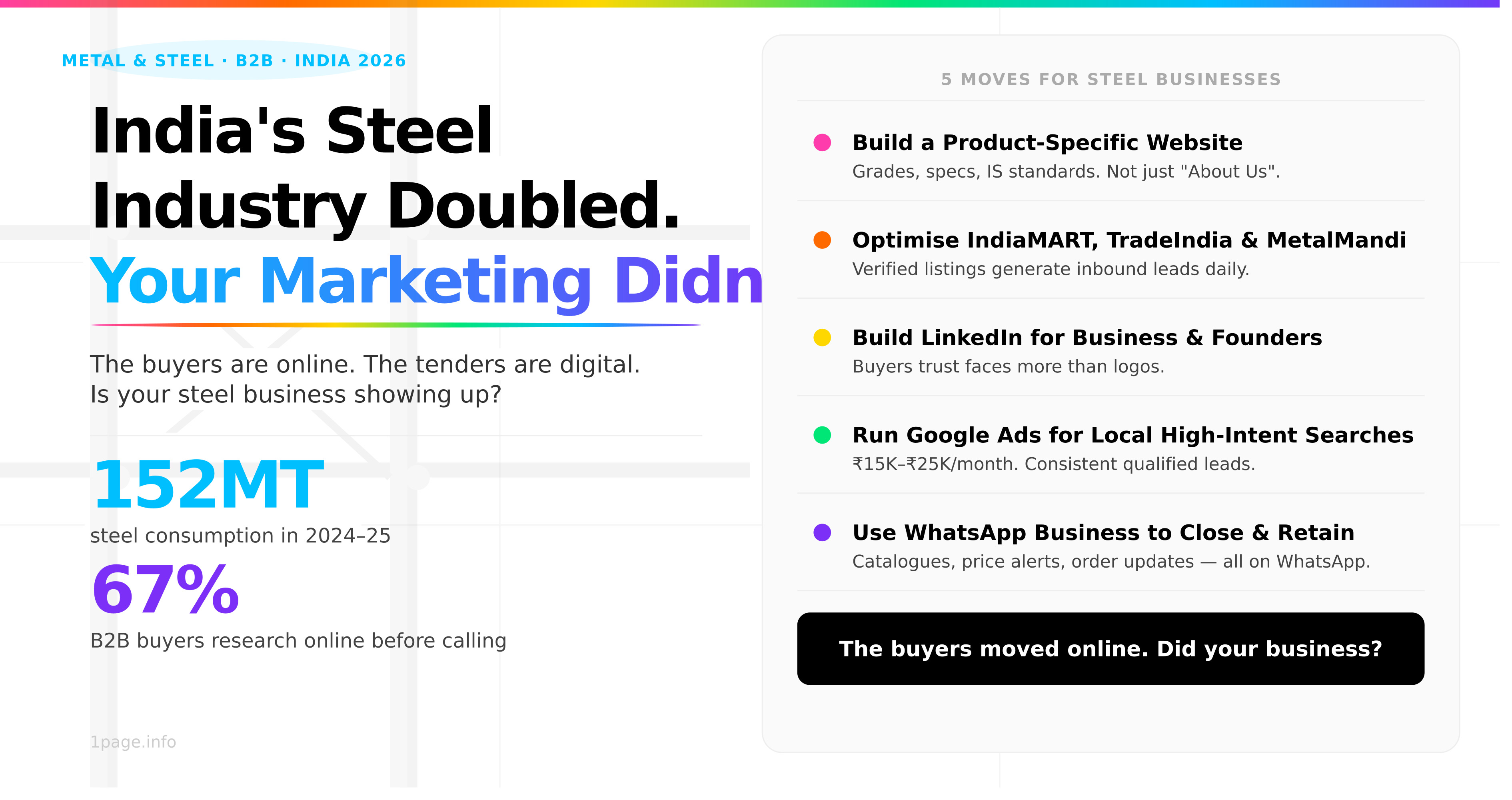
India's steel industry has a remarkable story to tell. Steel consumption jumped from 77 million tonnes in 2014–15 to 152 million tonnes in 2024–25 — and crude steel capacity is expected to reach 300 million tonnes by 2030–31. India is now the world's second-largest crude steel producer, with JSW Steel, Tata Steel, and SAIL expanding capacity at a pace the industry hasn't seen in decades.
The market is booming. The buyers are changing. And most steel manufacturers, distributors, fabricators, and traders in India are still selling the same way they did ten years ago — phone calls, broker networks, trade fair relationships, and word of mouth. That gap is the opportunity.
How B2B Buyers in Steel Are Researching in 2026
The procurement manager at a real estate developer in Hyderabad doesn't call three suppliers and pick the cheapest one anymore. 67% of B2B buyers prefer to complete their research independently before engaging a sales representative. They go online first. They search for TMT bar suppliers, structural steel fabricators, or MS pipe distributors in their region. They compare websites. They check LinkedIn profiles of companies and founders. They look for Google Reviews, case studies, and project portfolios. Then — after all of that — they make a shortlist and start calling.
In 2026, B2B marketing is buyer-led, not brand-led. Decisions are made before a sales call even happens. If your steel business doesn't exist online at the moment a buyer is researching, you are not on the shortlist. You are simply not in the conversation.
India's online B2B marketplaces have the potential to reach $200 billion by 2030, driven by accelerated adoption of digital channels, improved logistics, and increased supplier participation. Steel is one of the largest categories in this shift.
Why Steel Businesses Are Behind — And What It's Costing Them
The steel industry in India runs on relationships. Dealers know distributors. Distributors know contractors. Everyone has each other's number saved. And for decades, that was enough.
It is no longer enough.
The construction company sourcing steel for a new commercial project in Pune is comparing three suppliers simultaneously — one they found on Google, one from IndiaMART, and one their procurement head found on LinkedIn. The supplier with the best digital presence — the clearest website, the most detailed product catalogue, the strongest reviews, the most active LinkedIn page — gets the inquiry. The others get nothing, because the buyer never found them.
India's manufacturing sector is undergoing a structural transformation, driven by digitisation, global supply chain realignment and the growing need for efficient market access. B2B digital marketplaces have emerged as a critical enabler, connecting Indian manufacturers directly with global buyers — helping SMEs overcome traditional barriers related to scale, credibility and international reach.
Most small and mid-sized steel businesses in India have not made this shift yet. That means the window to get ahead is wide open.
5 Digital Marketing Moves Every Steel Business Needs Right Now
1. Build a product-specific website with real specifications. A basic "About Us" website is not a digital presence. Steel buyers need product pages with actual specifications — grades, dimensions, tolerances, IS standards, available sizes, and minimum order quantities. A TMT bar distributor in Raipur with a clean, detailed product website will consistently get more inquiries than a competitor with a better product and no online presence.
2. Get listed and optimised on 1page.info , IndiaMART, TradeIndia, and MetalMandi. Platforms with rigorous verification help build stronger buyer confidence, and those offering analytics, inquiry management, and lead scoring provide a competitive advantage. A fully optimised IndiaMART listing with verified certification, product photos, pricing ranges, and genuine buyer reviews is the single fastest way for a steel business to start generating inbound inquiries.
3. Build a LinkedIn presence for your business and its founders. Indian buyers trust faces more than logos. Founders who build personal authority on LinkedIn outperform corporate pages. A steel distributor whose owner posts consistently about market trends, steel prices, project case studies, and industry news will build credibility with exactly the procurement managers, contractors, and developers they want to reach — without spending a rupee on advertising.
4. Run targeted Google Ads for high-intent local searches. "TMT bar supplier Nashik." "MS channel dealer Surat." "Structural steel fabricator Pune." These are searches that happen every day — by buyers with real procurement needs, searching for suppliers they don't already know. A Google Ads campaign targeting these high-intent, location-specific queries with a budget of ₹15,000–₹25,000 per month can generate a consistent pipeline of qualified inbound inquiries for any steel business in India.
5. Use WhatsApp Business to convert and retain buyers. WhatsApp has more active users in India than Instagram, Facebook, and LinkedIn combined — and for B2B sales teams, it is the channel where proposals close. Steel businesses that send product catalogues, price updates, and availability alerts via WhatsApp Business — with segmented lists for different buyer categories — are building relationships that compound over time. Set up WhatsApp Business API, build broadcast lists, and make it frictionless for buyers to reach you.
The Window Is Open Right Now
The Bharat Steel 2026 Summit brought together global steel leaders to discuss digital transformation, sustainable steelmaking, and India's ambition to become a net-export steel power. The big players — JSW, Tata, SAIL — are already investing in digital transformation at scale. The question for smaller manufacturers, distributors, and traders is whether they build their digital presence now, while the competitive gap is still large, or wait until every competitor has caught up.
India's steel market is heading to 300 million tonnes. The buyers are online. The tenders are going digital. The procurement managers are researching on Google and LinkedIn before they pick up the phone.
Is your steel business showing up — or is your competitor?