
The Indian travel market has never been more profitable than it is now. Yet, almost all of the tour operators fail to capitalize on it.
As per forecasts, the online travel market in India will rise from $23.34 billion in 2025 to $25.38 billion in 2026 and is projected to amount to $38.58 billion by 2031. Domestic tourism accounts for 80% of all revenues from tourism in India, while in 2025-2026, there were more than 210 crore domestic trips taken in the country. A rise in cultural tourism by 45% is expected for 2026.
Despite all this, the typical Indian travel operator, endowed with outstanding itinerary planning skills, local knowledge, and years of experience, is unknown to the traveller in search of precisely what he offers.
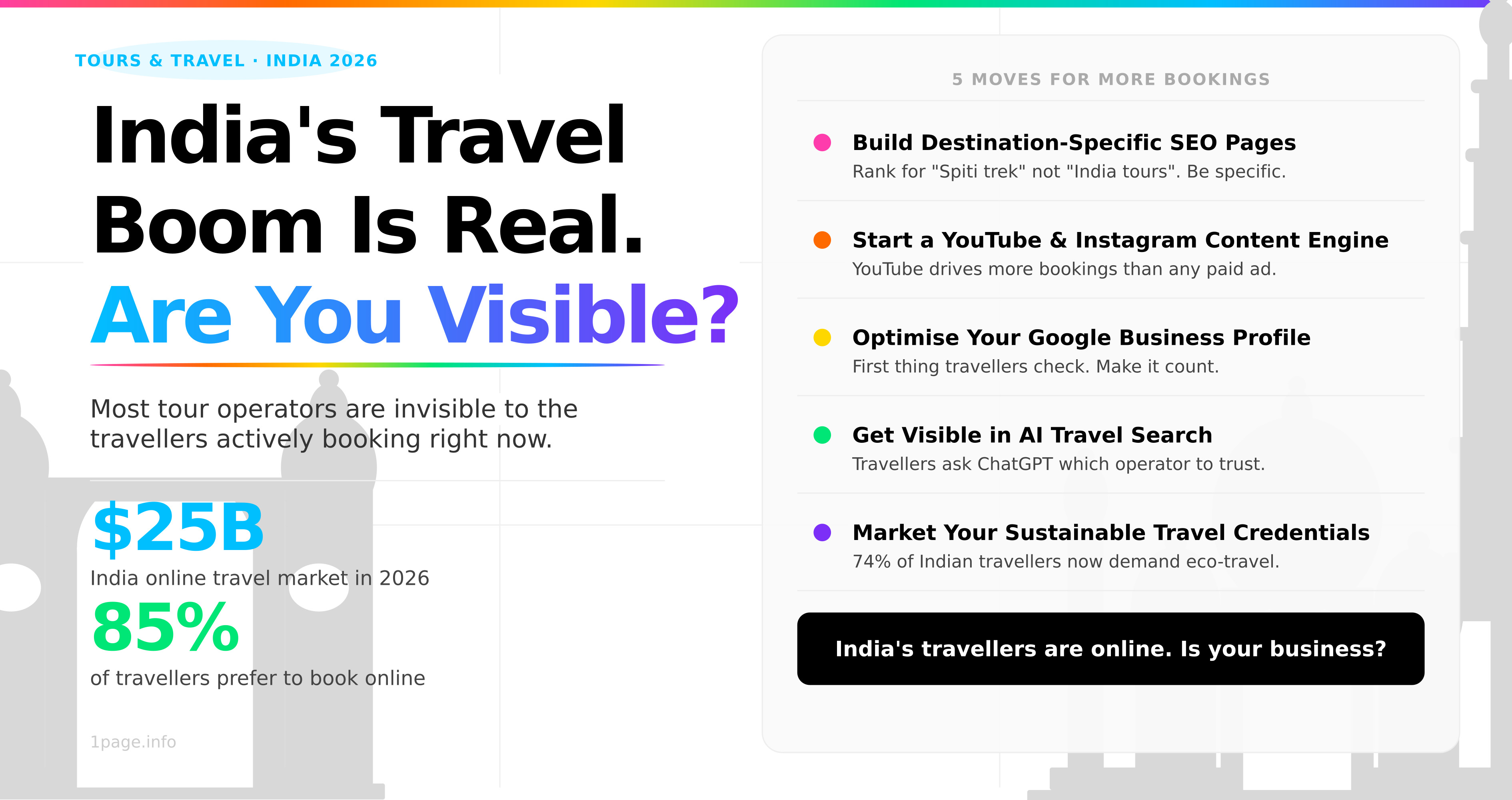
85% of travellers from India opt to make their bookings online. The two most popular touchpoints for Indian travellers throughout their entire buying journey are YouTube and Google. If you do not have your travel business featured prominently on these two platforms during all stages of their journey, you will be making it easy for your competitors to get those bookings.
How Indian Travellers Actually Book in 2026
Indians aren’t travelling less; they’re just travelling in a different way. There is no longer any spontaneity when booking holidays as Indians have begun thinking more strategically about the entire process. People have become more selective with respect to their booking decisions.
In other words, how is this reflected in reality? If you are thinking about visiting Spiti Valley or Coorg, there is no need to contact a travel agency. Instead, you will be watching YouTube videos about the destination. You are searching "the best time to visit Coorg 2026" on Google. You are reading blog reviews and comparing packages offered by different operators. You are looking at Google reviews of these operators. You are scrolling through Instagram to get inspired. You ask ChatGPT to suggest an operator.
As much as 44 percent of vacationers spend a week or more researching and making plans for their vacation through YouTube and Google. That's an opportunity for your business to be seen at every turn, or be missed at every turn.
Expenditures on experiential vacations, premium accommodations, and carefully crafted itineraries by Indian tourists are increasing, thereby making their travel decisions based more on other factors than just cost considerations alone. The tourist who will be paying Rs 80,000 for a tour to Ladakh is definitely not the one who is going for the least expensive one.
Why Most Tour Operators Are Invisible Online
The Indian travel industry is growing, and the war to catch their attention is completely fought through digital means by 2026. However, many solo travel companies and travel agents fight the war invisibly. A website created in 2018 without any SEO optimization. An Instagram account with just 200 followers with no constant posts being made. The Google Business listing page that hasn't been completed or even verified yet. None of them are on AI generated travel suggestions.
What happens here is MakeMyTrip, Cleartrip, and Kesari Travels grab all the attention of digital tourists, whereas the small company with more information and a better itinerary remains unseen. This is not an issue of lack of product. This is an issue of lack of visibility.
5 Digital Marketing Moves Every Tour Operator Needs Right Now
1. Create SEO pages specifically targeting each destination.
General pages such as “Tour Packages in India” will never give any results. You must develop individual pages for each destination and each kind of travel that you offer, including pages like “Packages for trekking in Spiti Valley,” “Houseboats on Kerala backwaters,” “Heritage Tours in Rajasthan leaving from Delhi,” “Ladakh biking trip in June 2026.” These are precisely the search queries that your potential clients are using.
2) Start your YouTube and Instagram content machine.
Indians are likely to visit YouTube more often than any other platform when they require to make their booking decisions right away. For a tour operator that consistently posts destination stories and reels on Instagram and YouTube, this is much more than just producing content; this becomes the most compelling trust indicator possible. A sixty-second Instagram Reel showing a sunrise from Pangong Tso or a walk around a coffee plantation in Coorg will do wonders for your bookings compared to any ad campaign you may run.
3. Get your Google Business Profile optimised fully.
When any traveller searches locally for an agency that can handle their travel requirements in your city, the first thing they come across is your Google Business Profile. And if your profile is incomplete or has no photos or less than 10 reviews, you are definitely losing out on business even before they visit your site. Add photos of your tours, add your services and specialties, and ensure Google Reviews are collected systematically.
4) Visibility in AI-powered tourism searches.
As increasing numbers of Indians turn to ChatGPT and Perplexity to ask about "the best tour operators in Ladakh" and "what tourism agency in Mumbai provides trips to Bhutan," you should be aware that if your company has none of the three key elements - content structure, author authority and external references - on your website, you won't even show up in their responses.
5. Focus on sustainable and experiential demand.
74 percent of Indian travelers require immediate action on environmental initiatives from the travel industry, so it is not only a necessary part of the competition, but an essential one, not a niche anymore. Those tour operators who have been clear about their sustainable initiative, such as local accommodations and carbon credits, etc., can target a growing number of Indian travelers who do that.
The Opportunity Is Bigger Than You Think
The mobile bookings sub-segment in India’s online travel market space will grow at a 14.39% CAGR from 2026-2031. 50 lakhs additional tourist employment opportunities are anticipated to be created by 2030. The market is not growing slower but faster. Those tour operators that build their digital foundation today can multiply the gains each season. Those that are waiting will become increasingly caught between big OTAs that have bottomless pockets for advertising and tour companies that are ahead of them by six months.
Today’s Indian traveler gets his inspiration from YouTube, researches via Google, verifies through AI, and books online. Your tour company needs to be there every step of the way – or you will miss it.